


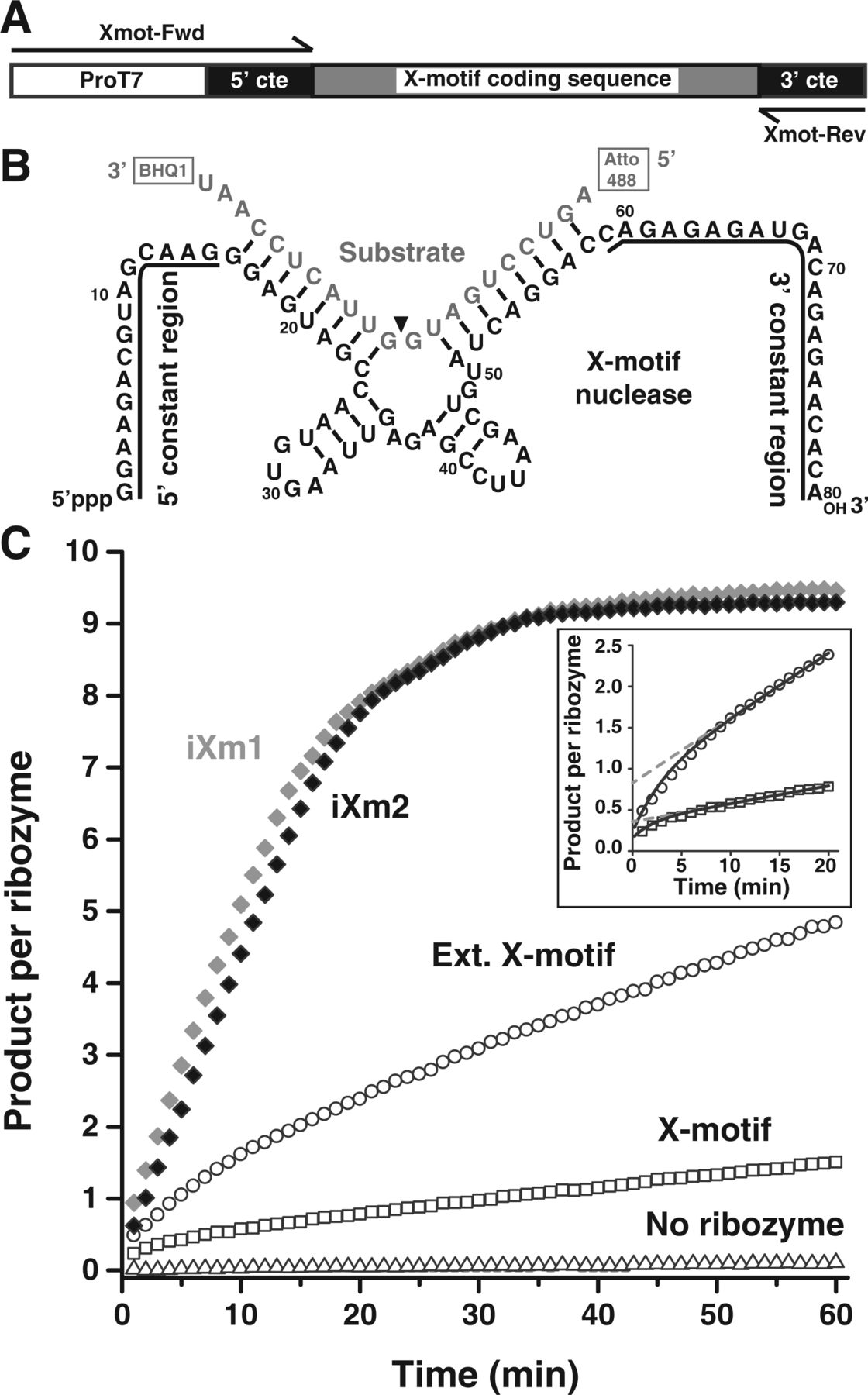
Structure and activity of the original X-motif and its extended form. (A) Organization of extended X-motif coding gene. The extended X-motif coding sequence was placed under the control of a T7 RNA polymerase promoter (ProT7). Annealing sites of amplification primers (Xmot-Fwd and Xmot-Rev) are represented by arrows. (B) Secondary structure model. The catalytic core of the X-motif nuclease is shown as proposed previously (Lazarev et al. 2003). The constant regions appended to both ends of the extended ribozyme are underlined. The nuclease is shown in complex with its fluorogenic substrate (in gray) and the cutting site is indicated (black triangle). Before the reaction occurs, the fluorescence of Atto488 (ex. 488 nm/em. 525 nm) is quenched by the BHQ1 quencher (Abs. 480–580 nm). Upon cleavage, a fluorescent product is released and signal is observed. (C) Ribozyme activity assay. X-motif (open squares), its extended form (open circles), iXm1 (gray diamonds), and iXm2 (black diamonds) were incubated with a 10-fold molar excess of fluorogenic substrate at 37°C and the fluorescence monitored with time. A burst phase was observed during the first 20 min (inset) of the reactions catalyzed by X-motif (open squares) and its extended form (open circles), but not for the evolved variants iXms. Burst phase kinetics was fitted to the burst equation (Wanninayake and Walker 2012). The fit is shown in black and the extrapolation of the linear phase to t0 is shown as a gray dashed line. This allowed determination of kburst, kcatss and the fraction of active X-motif and extended X-motif reported in Table 1. The kcatss for the evolved ribozymes iXm1 and iXm2 were calculated from a linear fit to the initial rate. The reaction without ribozyme is also shown (open triangles).




