


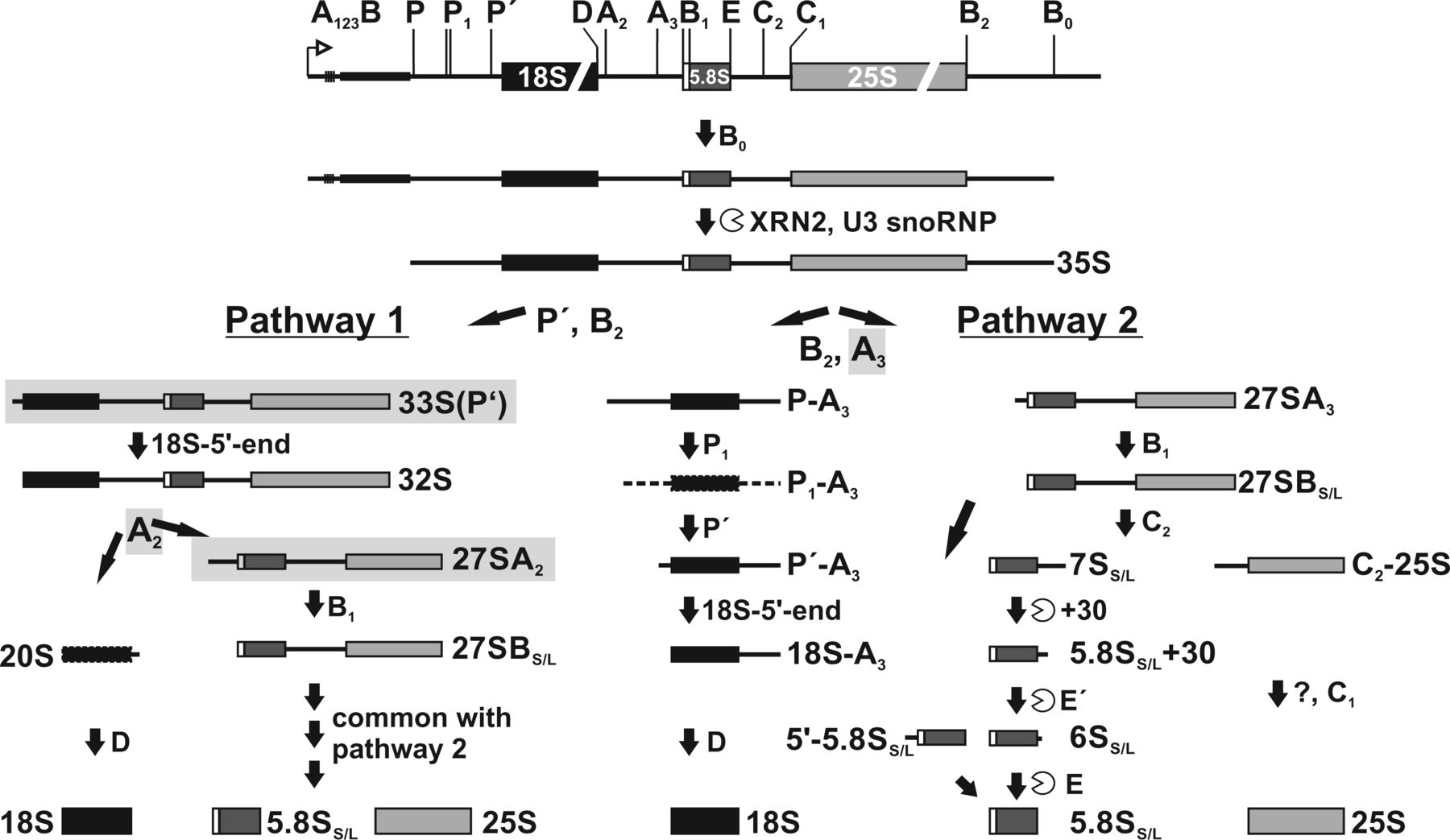
Two alternative rRNA processing pathways coexist in A. thaliana. A primary transcript is released by cleavage at site B0 mediated by atRTL2. Further processing involving the exonuclease atXRN2 and processing of the 1083-nt insertion prepares site P for efficient cleavage by the BoU3 snoRNP complex. (Left) In Pathway 1, the 35S pre-rRNA is processed at site P′ (33S[P′]) and subsequently at the mature 5′ end of 18S rRNA (32S), before A2 cleavage releases the 20S and 27SA2 pre-rRNAs. 20S pre-rRNA is rapidly matured to the 18S rRNA. (Right) Pathway 2 involves A3 cleavage to separate pre-40S and pre-60S particles. The resulting P–A3 fragment is subsequently processed at P1, P′, and the mature 5′ end of 18S pre-rRNA before the final processing step at site D occurs in the cytoplasm. 27SA2 (from Pathway 1) or 27SA3 (Pathway 2) are processed at site B1 before C2 processing separates them into 7S and C2–25S. The 7S pre-rRNA likely undergoes 3′→5′ exonucleolytic trimming that yields 5.8S + 30, 6S, and finally the mature 5.8S rRNA. Furthermore, a 5′ extended pre-5.8S rRNA is detectable in RNA from wild type, but its place in the processing scheme remains to be established. For further details and references see main text. Newly defined pre-rRNAs are marked by a gray box.




