


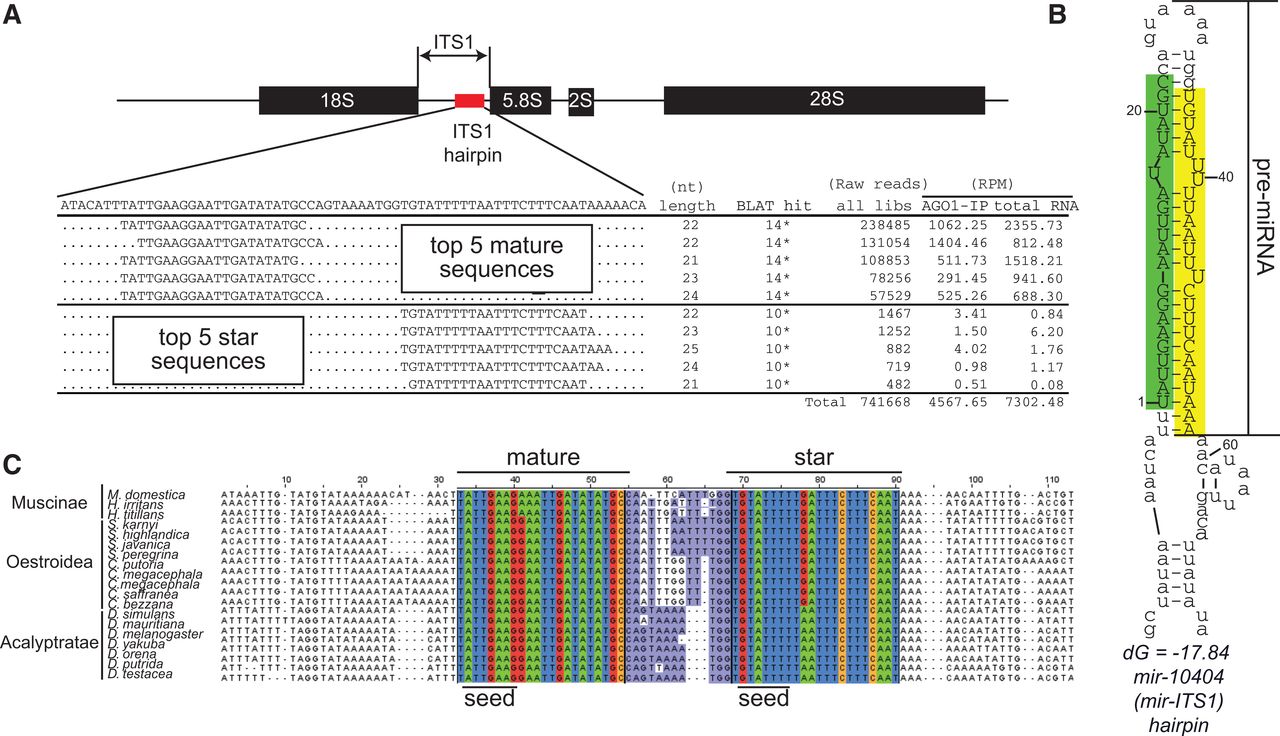
A conserved miRNA in rDNA ITS1. (A) Small RNA reads mapping to the ITS1 hairpin region. Total small RNA read counts were obtained from ∼90 small RNA libraries listed in Supplemental Table S1. For normalized read counts in ovary AGO1-IP and total RNA libraries, we used the number of reads mapping to annotated miRNA hairpins as a normalizer. The asterisk (*) indicates that the BLAT hit numbers shown on the table are the numbers of genomic positions the sequence can be perfectly mapped in the D. melanogaster reference genome. Note that the actual copy number of rDNA is not reflected in the genome assembly. Each of the two rDNA arrays in Drosophila melanogaster is estimated to contain hundreds of rDNA units (Long and Dawid 1980). (B) RNA folding of mir-10404/mir-ITS1 hairpin. The RNA sequence producing reads shown in A was folded by Mfold (Zuker 2003). The most abundant mature (5p) and star (3p) sequences were highlighted by green and yellow, respectively. The numbers beside the hairpin structure indicate relative nucleotide positions counting from the 5′ end of the major 5p species. The pre-mir-10404/mir-ITS1 hairpin sequence was defined as the sequence from the 5′ end of 5p to the 3′ end of 3p. Note that the flanking sequences do not form a stem structure, suggesting a lack of the lower stem structure that is essential for processing by the Microprocessor complex. (C) Sequence alignment of fly mir-10404/mir-ITS1 hairpin. The hairpin sequence is conserved in distant fly species whereas the surrounding sequences are highly diverged. The loop region (purple) shows faster evolution compared with the mature and star regions, exhibiting a typical “saddle-shape” conservation pattern. Note that the nucleotide substitutions occurring in the stem region are outside of the seed sequence.




