


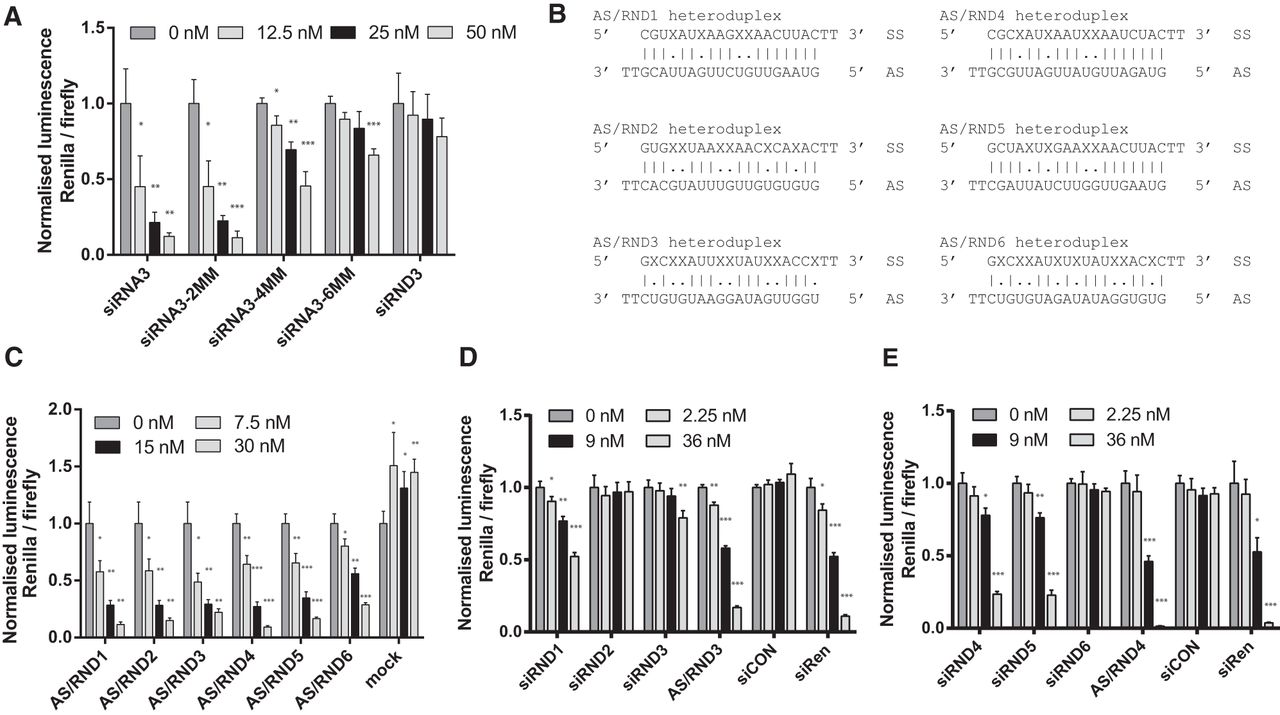
Silencing properties of siRNDs. (A) Dual luciferase reporter assay. SiRND3 and the nonrandomized mismatch controls were cotransfected with a dual luciferase reporter plasmid carrying a target site for siRNA3 antisense strand. Relative Renilla/firefly luciferase activity (hRLuc/hluc+) normalized to the 0-nM dose is shown in means of triplicate transfections ± SD. (B) Sequences of siRND sense strand and nonrandomized siRNA antisense strand heteroduplexes 1–6. Watson–Crick base pairs are indicated with a dash. Randomized positions are indicated with a dot. (C) Dual luciferase reporter assay. AS/RND siRNA heteroduplexes 1–6 were cotransfected with a reporter plasmid carrying the respective nonrandomized target site. Mock treatment corresponded to empty reporter plasmid transfection (psiCHECK-2) with increasing doses of AS/RND4. Relative luciferase activity (hRLuc/hluc+) was normalized to the 0 nM treatment and shown in means of triplicate transfections ± SD. (D,E) Dual luciferase reporter assays. Rnd-siRNAs were cotransfected with a reporter plasmid carrying the respective target sites. Heteroduplexes AS/RND's 3 and 4 were used as positive controls for the target site. SiRen and siCon served as positive and negative controls for the dual luciferase plasmid. Relative luciferase activity (hRLuc/hluc+) was normalized to the 0 nM treatment and shown in means of triplicate transfections ± SD.




