


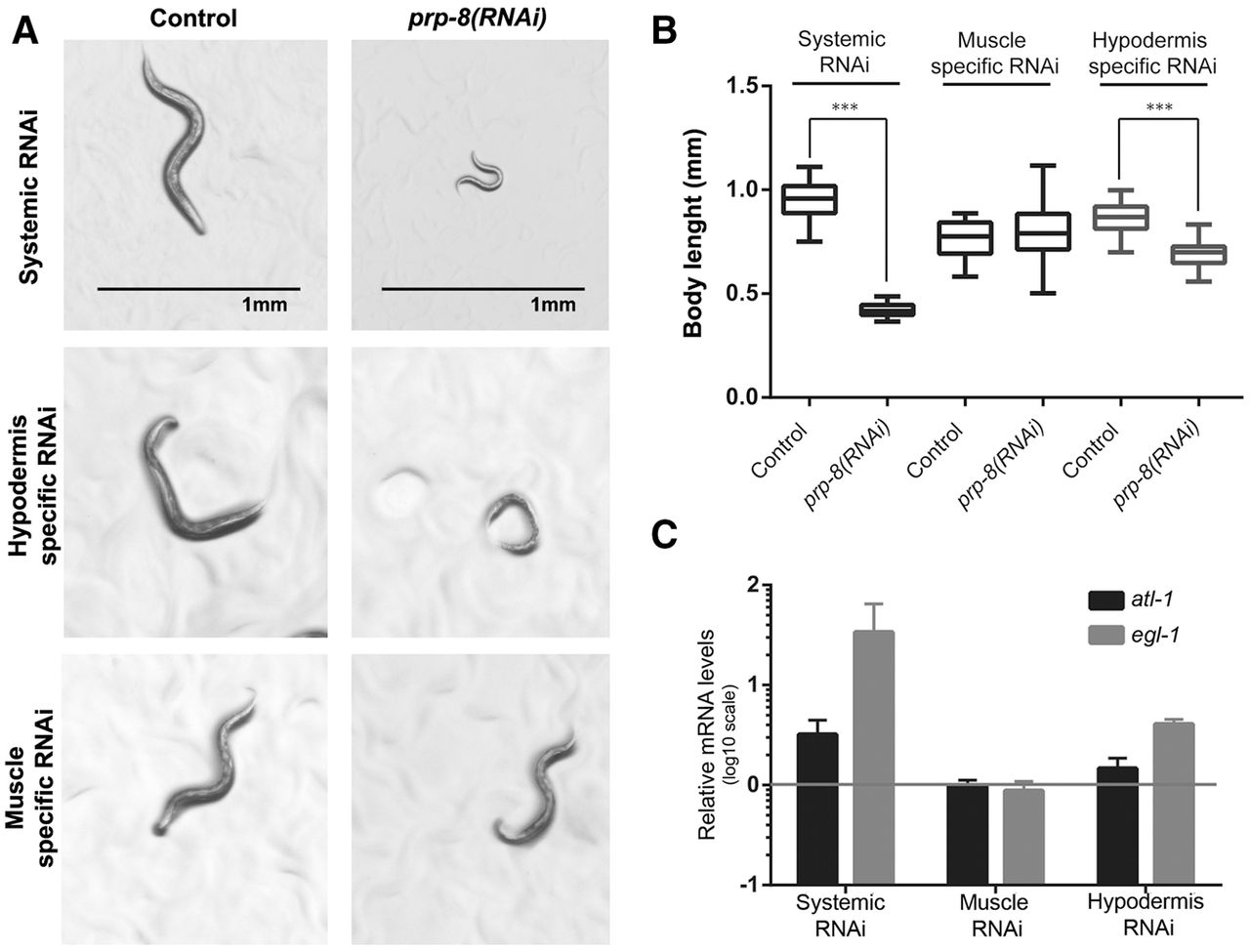
prp-8(RNAi) animals display tissue-specific phenotype. (A) Larval arrest phenotype was observed in wild-type- and hypodermis-specific RNAi animals (rde-1 (ne219) V; KzIs9), while no obvious phenotype was observed in muscle-specific RNAi worms (rde-1 (ne219) V; KzIs20). Representative images were taken under the stereoscope after 48 h at 20°C. Scale bar, 1 mm. (B) Body length measure of wild-type, and hypodermis- and muscle-specific RNAi animals fed with prp-8(RNAi) and control (empty vector) clones. Animals synchronized at L1 stage were treated with the corresponding RNAi clone and grown at 20°C. More than 25 worms were measured after 48 h of treatment in each condition. Animal length is showed in millimeters and was scored using the ImageJ software. Statistical significance was calculated using Student's t-test for independent samples. Three asterisks indicate statistical significance with P < 0.001. Whiskers were plotted by Tukey's test. (C) Up-regulation of atl-1 and egl-1 after prp-8(RNAi) is tissue specific. qPCR results for atl-1 and egl-1 expression in wild-type and hypodermis- and muscle-specific RNAi animals represented in a bar graph. mRNA levels of these genes after prp-8(RNAi) are relative to their expression in control animals. Results obtained from three independent biological replicates. mRNA transcript levels of atl-1 and egl-1 are normalized against tbb-2 levels and represented in a log10 scale in both experiments. Error bars represent standard deviation.




