


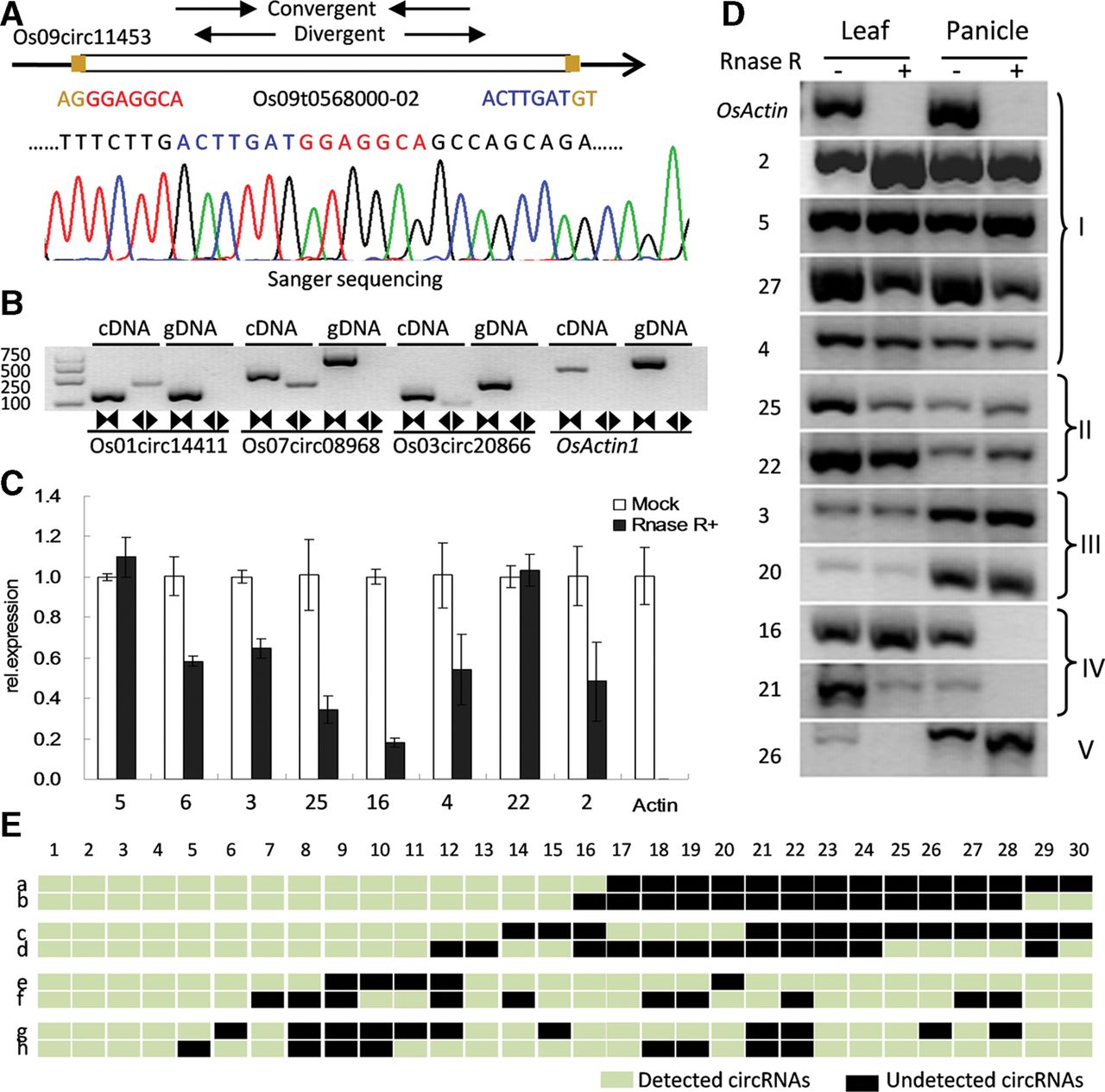
Various experimental strategies validated the stable expression of rice circRNAs. (A) An example of rice circRNAs (Os09circ11453) shows the validation strategy. Divergent and convergent primers were designed to detect circular RNAs. Sanger sequencing further confirmed head-to-tail backsplicing. (B) Divergent primers (black back-to-back triangle pairs) successfully amplified three circRNAs (Os01circ14411, Os07circ08968, and Os03circ20866) in cDNA but failed to do so in genomic DNA. Convergent primers (black opposing triangle pairs) worked on both cDNA and genomic DNA. (OsActin1) Linear control. (C) Here, qRT-PCR shows that eight circRNAs are stably expressed in both RNase R(−) and RNase R(+) total RNA samples, whereas the linear control was not expressed in RNase R(+) samples. (D) RT-PCR further shows that 11 circRNAs are RNase R-resistant. Some circRNAs showed tissue-specific expression. (I) circRNAs highly expressed in both tissues; (II) circRNAs highly expressed only in leaf; (III) circRNAs highly expressed only in panicle; (IV) circRNAs specifically expressed in leaf; and (V) circRNAs specifically expressed in panicle. (E) Expression results of 30 circRNAs in leaf and panicle poly(A)− and poly(A)+ samples, summarized according to ssRNA-seq data and RT-PCR. (a) Results obtained from leaf poly(A)+ ssRNA-seq; (b) results obtained from leaf poly(A)+ RT-PCR; (c) results obtained from panicle poly(A)+ ssRNA-seq; (d) results obtained from panicle poly(A)+ RT-PCR; (e) results obtained from leaf poly(A)− ssRNA-seq; (f) results obtained from leaf poly(A)− RT-PCR; (g) results obtained from panicle poly(A)− ssRNA-seq; and (h) results obtained from panicle poly(A)− RT-PCR. Note: The name of each circRNA has been indexed in Supplemental Table 5 and Supplemental Figure 2.




