


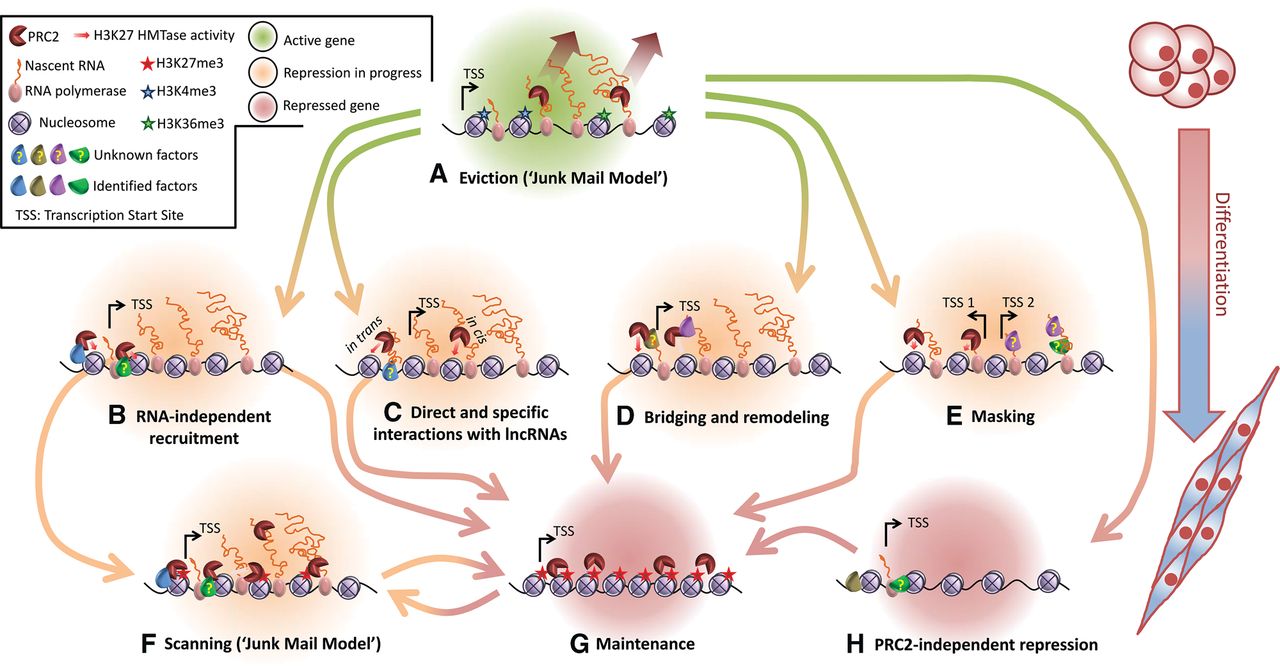
Previously proposed models for the recruitment of PRC2 to chromatin by lncRNA, and RNA in general, compared with RNA-independent recruitment mechanisms. (A) Eviction (“Junk Mail Model”): Promiscuous RNA binding to nascent transcripts leads to eviction of PRC2 from highly active genes (Davidovich et al. 2013; Kaneko et al. 2013) and inhibits its HMTase activity (Cifuentes-Rojas et al. 2014; Herzog et al. 2014; Kaneko et al. 2014b). Simultaneously, H3K4me3 and H3K36me3 active chromatin marks prevent deposition of PRC2 to nucleosomes and inhibit its HMTase activity (Schmitges et al. 2011; Yuan et al. 2011). (B) RNA-independent recruitment: PRC2 is recruited to chromatin through interactions with protein-binding factors, nucleosomes, and/or DNA (for reviews, see Ringrose and Paro 2007; Margueron and Reinberg 2011; Di Croce and Helin 2013; Simon and Kingston 2013; Comet and Helin 2014). (C) Direct and specific interactions with lncRNAs: Site-specific recruitment of PRC2 could occur in cis or in trans (references in text). (D) Bridging and remodeling: Recruitment of PRC2 by RNA can be mediated through protein bridging factors, such as JARID2 (da Rocha et al. 2014; Kaneko et al. 2014a,b), or through RNA structure remodeling, as suggested for ATRX (Sarma et al. 2014). (E) Masking: PRC2 is masked from binding to certain RNA transcripts that are already bound by other factors, thus providing a binding preference (Herzog et al. 2014). (F) Scanning (“Junk Mail Model”): PRC2 interacts with nascent RNA transcripts promiscuously (Davidovich et al. 2013; Kaneko et al. 2013) and scans for repressive epigenetic marks or recruiting factors. Unless deposition to nucleosomes takes place, PRC2 is poised and in check (Kaneko et al. 2014b) while its HMTase activity is inhibited by the RNA. (G) Maintenance: After repression is achieved, PRC2 maintains the repressed epigenetic state through direct binding to nucleosomes carrying H3K27me3 marks (Hansen et al. 2008), which also stimulate its HMTase activity (Margueron et al. 2009). (H) PRC2-independent repression: Transcription shutoff of a Polycomb target gene can take place in a PRC2-independent manner and can lead to subsequent recruitment of PRC2 (Riising et al. 2014). Importantly, most of these models are not mutually exclusive.




