


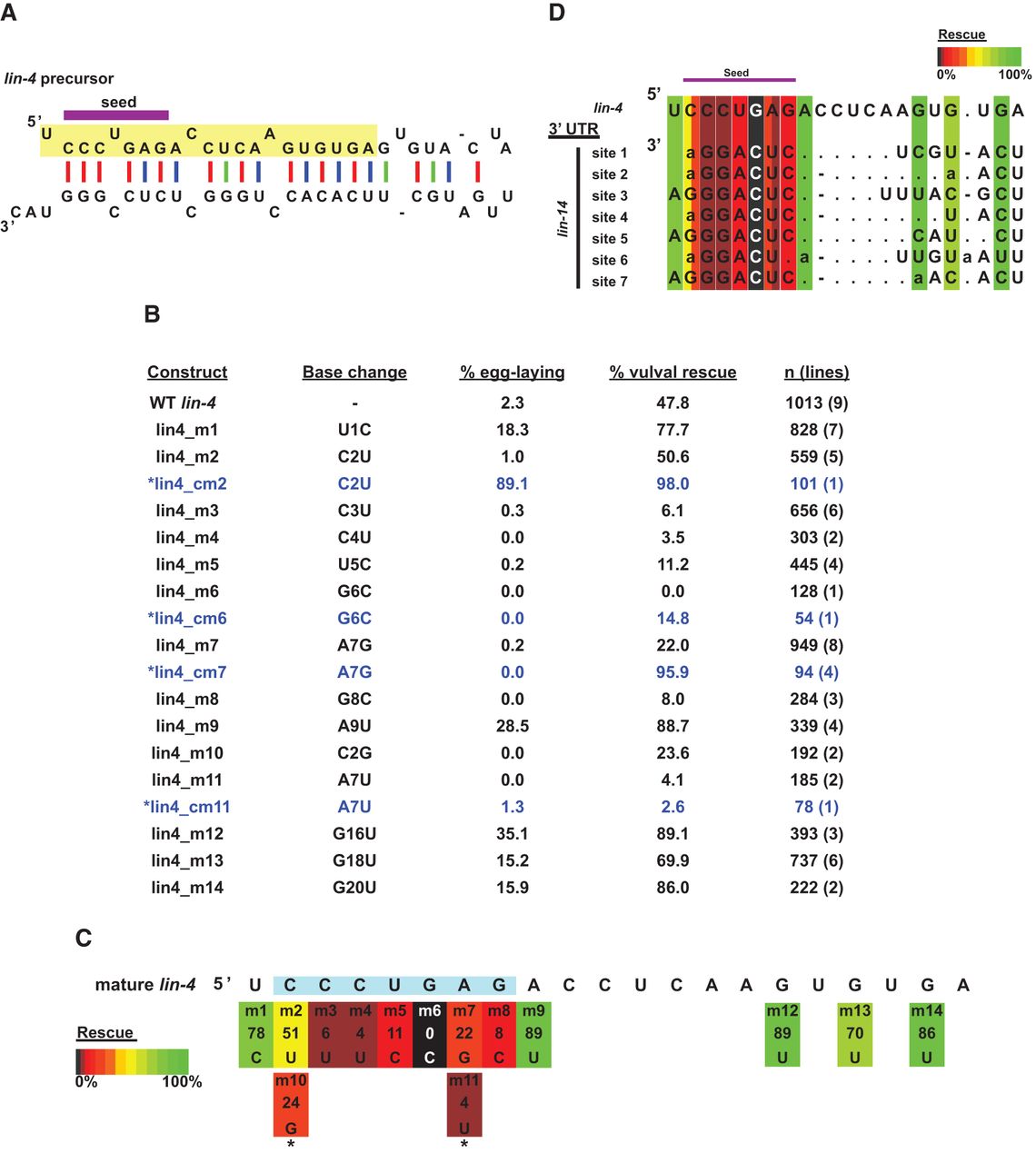
lin-4 rescue is drastically affected by central seed mutations while peripheral seed mutations retain activity. (A) Partial lin-4 precursor structure with the mature lin-4 microRNA highlighted (yellow box). Red and blue lines represent Watson–Crick base pairs (C:G and A:U, respectively), with green lines representing wobble base pairs (G:U). (B) Percentages of transgenic animals exhibiting vulval morphology and egg-laying rescue for each lin4_m construct are shown. Results from CRISPR/Cas9-derived lin-4 mutant animals are in blue (lin4_cm). “n” refers to total number of animals assayed for each lin4_m/lin4_cm mutation, with the subsequent value in parentheses referring to the total number of independent lines assayed. For completeness, we have included a construct (lin4_m6) tested in a single line; although subject to doubt accompanying any individual transgenic line, we note (i) a strong consistency between multiple independently derived lines from other constructs tested in this study, (ii) effects on rescue were consistent with those of other proximal alterations, and (iii) supporting data from endogenous lin-4 mutants (lin4_cm6). (C) lin-4 mutations and their rescue activities. The seed sequence is highlighted by the light blue box. The different colored boxes below lin-4 sequence represent different levels of lin-4 vulval rescue activities (gray = 0.0%, yellow = 50.0%, and green = 100%) corresponding to the lin4_m mutation depicted in the box at the same position. The numbers within the colored boxes are the average percentages of transgenic mutant animals showing vulval rescue. The two mutations marked with an asterisk (*) are mutations that result in loss of pairing with known target binding sites, in contrast to the mutations depicted above that result in wobble pairing at those positions. (D) Binding sites in lin-14 3′ UTR (bottom) are aligned against lin-4 mature microRNA (top) (Lee et al. 1993; Lewis et al. 2005; Bartel 2009; Jan et al. 2011). Dots indicate absent bases at those positions; dashes indicate one or more noncomplementary bases. Lowercase letters represent complementary bases as a result of mutations made in lin4_m constructs. First miRNA nucleotides and alignments of 5′ ends of binding sites have been included for completeness although their functionalities have not been demonstrated. Colored bars represent levels of lin-4 vulval rescue ([gray] 0.0%, [yellow] 50.0%, [green] 100%) for mutations at specific positions. A position that is highlighted by two colored bars has two different mutations at the same position and each color represents the rescue activity of each specific mutation.




