


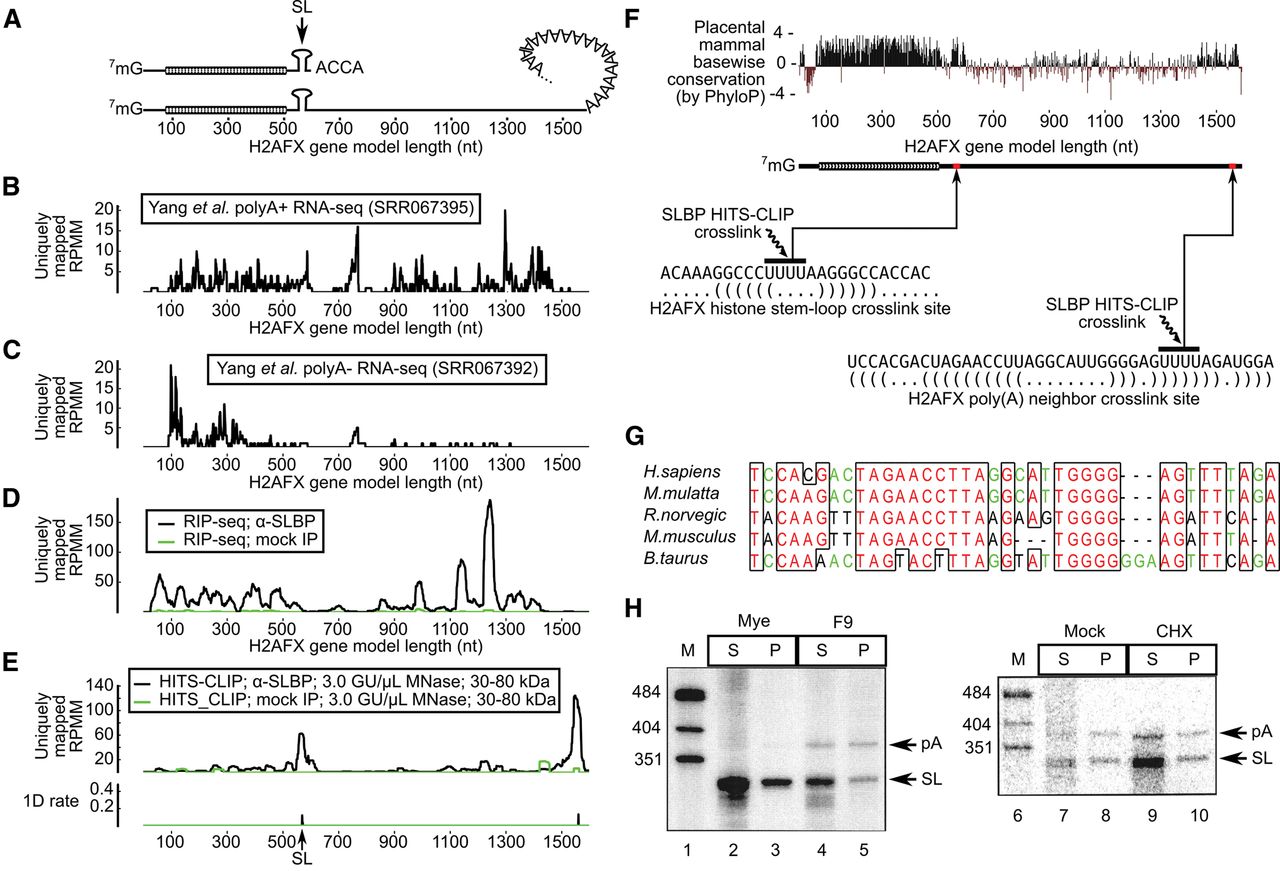
Proteins in the SLBP immunoprecipitate interact with H2AFX mRNA at two distinct sites. (A) Schematics of the short and long H2AFX mRNA isoforms are shown. (B,C) The RNA-seq data sets from Yang et al. (2011) produced by sequencing the (B) polyadenylated and (C) nonpolyadenylated fractions of HeLa cell mRNA isolates were aligned and displayed. Reads per million mapped reads (RPMM) is plotted for each nucleotide across the bimorphic H2AFX transcript. (D) Analysis of H2AFX mRNA read coverage in our SLBP RIP-seq data set. (E) Analysis of H2AFX mRNA read coverage in our SLBP HITS-CLIP data set. The middle panel shows the HITS-CLIP CIMS (1D rate) with a peak in the histone SL and a peak near the poly(A) site. Shown in the lower panel is the placental mammal conservation which demonstrates conservation of the coding region, histone SL, and the region preceding the poly(A) site. (F) The sites of crosslinking deduced from the sites of indels in the SL and in the sequence adjacent to the poly(A) site are indicated. (G) Comparison of the sequences around the polyadenylation site in the H2AFX gene in different mammals showing the sites of crosslinking defined by the presence of Indels, and the conservation among mammalian species. (H) Total cell RNA from exponentially growing mouse myeloma cells (lanes 2,3) and F9 teratoma cells (lanes 4,5,7,8), or F9 cells treated with cycloheximide for 60 min (lanes 9,10) to freeze the ribosomes and stabilize the stem–loop RNA, were lysed and the histone mRNAs precipitated with anti-SLBP antibody. RNA was prepared from the supernatants (S) and the immunoprecipitates (P) and subjected to S1 nuclease mapping as preciously described (Whitfield et al. 2004). The probe was hybridized with total cell RNA, treated with S1 nuclease, and the protected fragments resolved by electrophoresis on an 8% polyacrylamide-7 M urea gel. Lanes 1 and 6 are markers. The SL form of H2AFX RNA protects a 333-nt fragment, and the polyadenylated form protects a 379 fragment as the probe extends 46 nt past the end of the SL, complementary to the H2AFX gene.




