


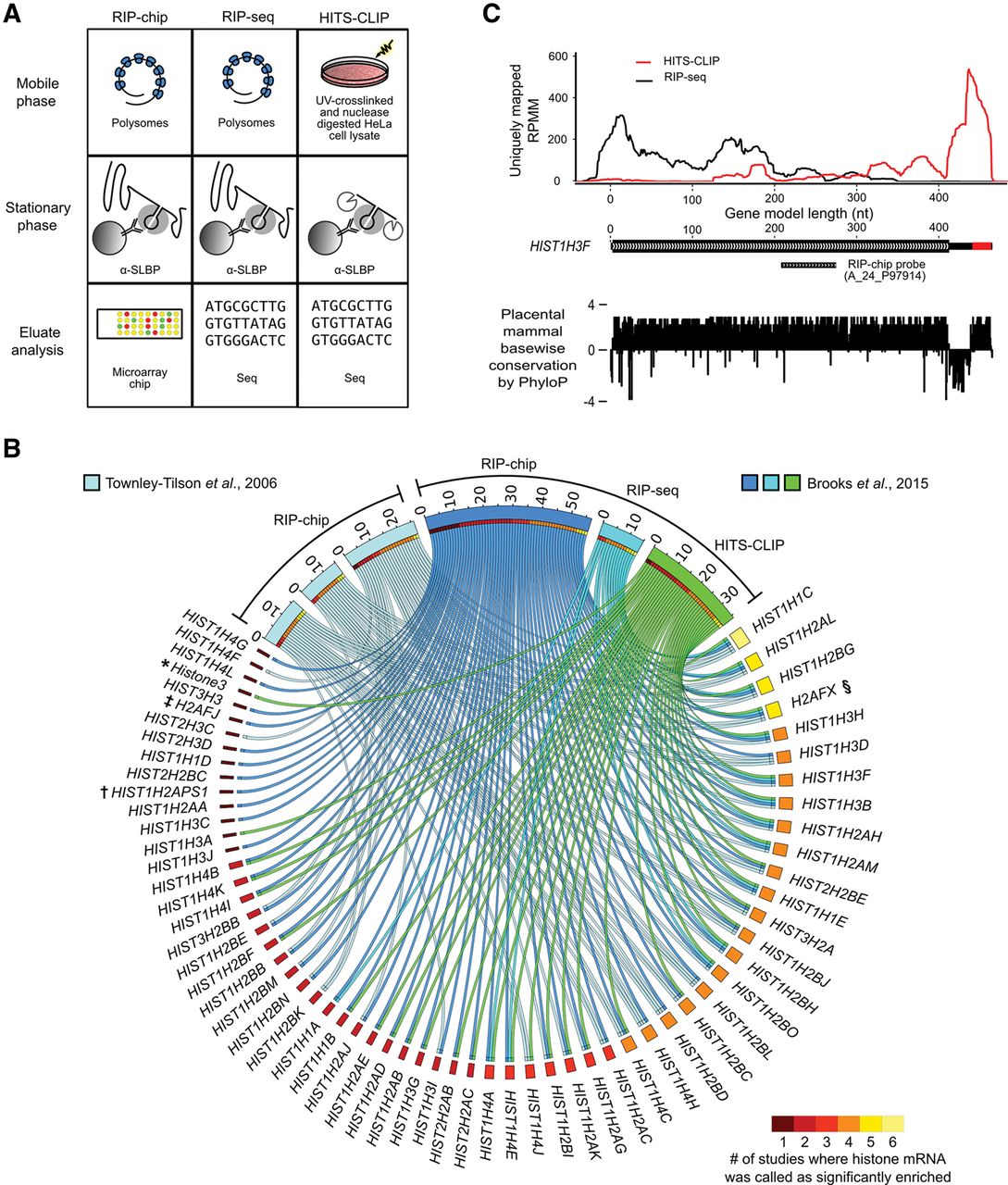
Genome-wide analysis of SLBP RNA ligands. (A) Affinity chromatography strategies for the three different genomic techniques that we utilized are shown. (B) Circos plot (Krzywinski et al. 2009) showing histone genes that have been identified as significantly enriched using RIP-chip, RIP-seq, and HITS-CLIP. Histone3, denoted by (*), indicates the accession number for this annotation in the Known Gene database (Hsu et al. 2006) is uc021yox.1. This is an Rfam entry that maps to the HIST1H2BK gene, which is misannotated. The HIST1H2APS1 gene (†) is a pseudogene, which is not expressed, and the appearance of this gene in the significantly enriched probe set is certainly a microarray cross-hybridization artifact. The H2AFJ gene (‡) does not have a stem–loop, which indicates that this is also likely a microarray cross-hybridization artifact. The H2AFX gene (§) is a notable mRNA target of SLBP because it is bimorphic. (C) Read coverage distributions for the RIP-seq and HITS-CLIP experiments and the microarray probe location for the HIST1H3F gene. The stem–loop region is marked by a red block in the gene model schematic and is highly conserved across placental mammals (Pollard et al. 2010). HITS-CLIP is the only technique that provides direct evidence of the SLBP site. Coverage distribution is expressed as reads per million mapped (RPMM).




