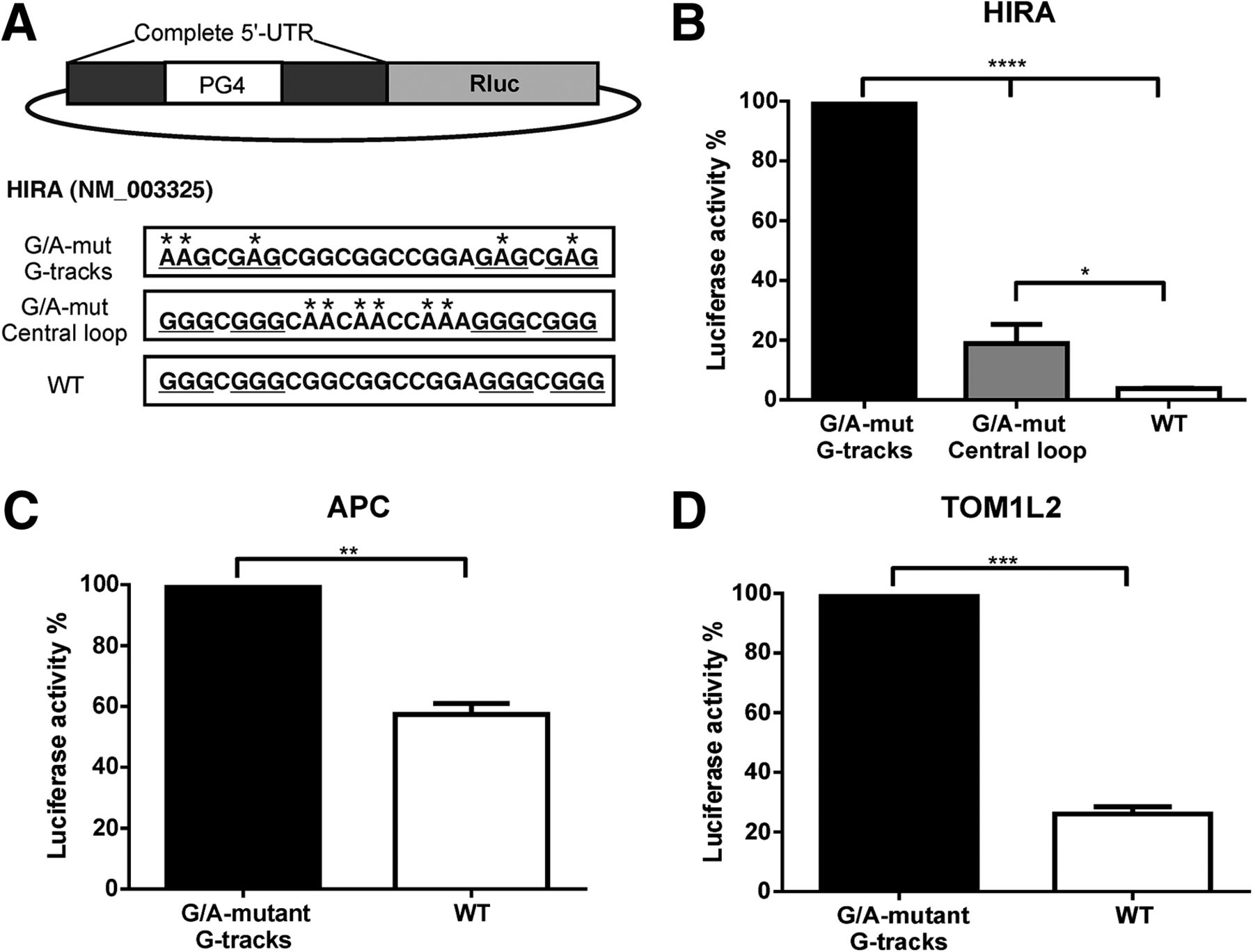
Effect of a G-quadruplex possessing a long central loop on luciferase activity. (A) Schematic representation of the vector construction with the different sequences used for the HIRA candidate constructs. The PG4 region is boxed, the guanines involved in the G-tracks are underlined, and nucleotides identified with an asterisk are the guanines that were mutated to adenines in the different G/A-mutant constructs. Values were first normalized by dividing the value of Rluc by the value of the control Firefly luciferase (Fluc). The percentage (%) of luciferase activity was set to 100% for all of the G-tracks G/A-mutant constructs. The luciferase activity values of the other construct were divided by the value of their corresponding G-tracks G/A-mutant construct and then multiplied by 100. (B) Luciferase activity of the different HIRA constructs each with a central loop of 11 nt. (C) APC possessing a central loop of 30 nt, and (D) TOM1L2 possessing a central loop of 32 nt. For these three examples, the wt constructs which can fold into a G-quadruplex reduced the luciferase activity. The results are the means of at least two independent experiments, and the error bars represent the standard deviations. P-value were calculated by unpaired Student t-test. (*) P < 0.05, (**) P < 0.01, (***) P < 0.001, (****) P < 0.0001.