


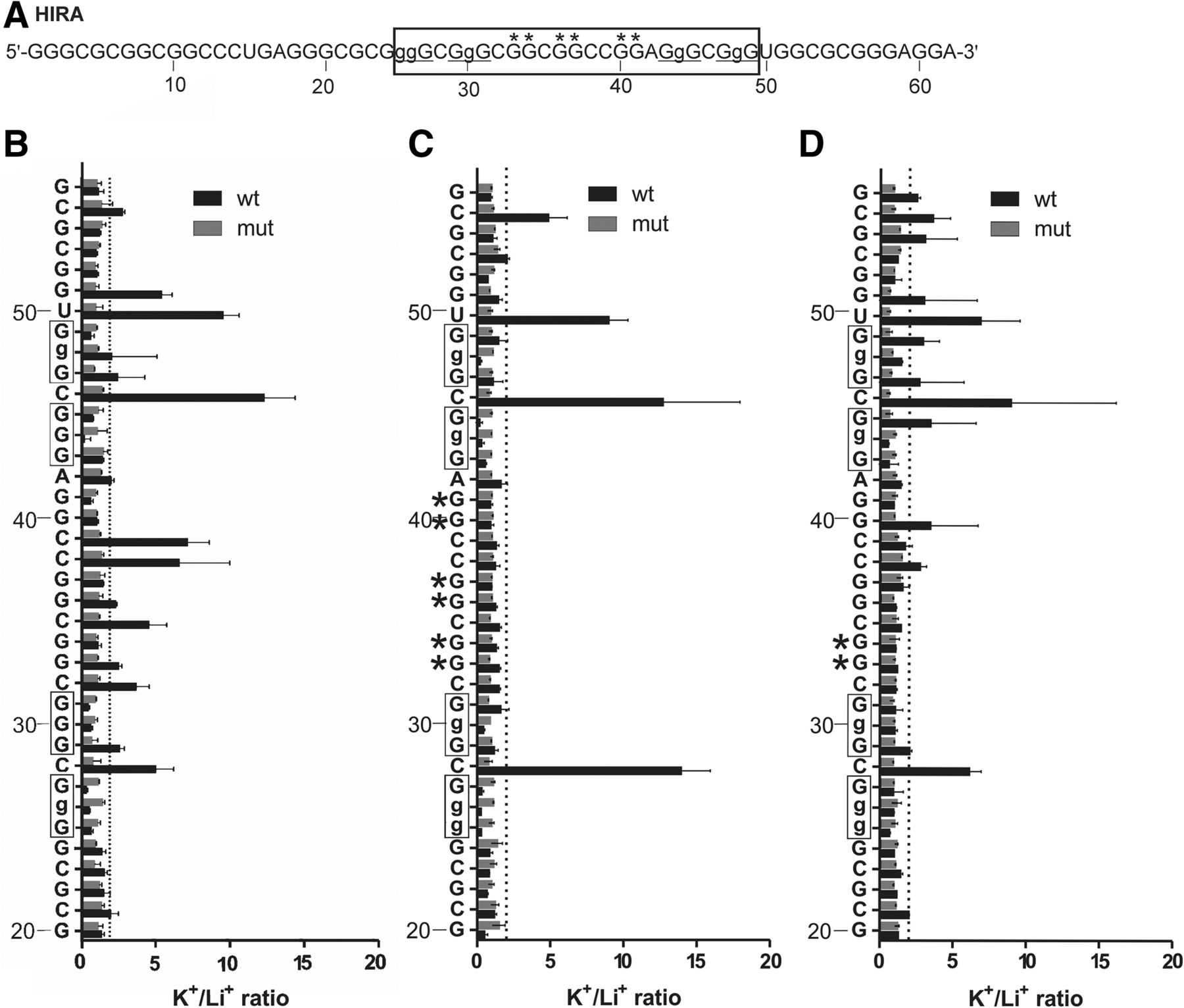
In-line probing results of the HIRA PG4 candidate which possesses an 11-nt central loop. (A) Nucleotide sequence of the characterized HIRA wt transcript. The lowercase guanines (g) correspond to those substituted for adenines in the G/A-mutant version. Guanines mutated in the central loop are denoted by asterisks (*). Underlined G-tracks indicate the nucleotides predicted to be involved in the G-quadruplex formation. The boxed sequence denotes the predicted PG4. (B–D) K+/Li+ ratios of the band intensities of the HIRA wt and the G/A-mutant in vitro G-quadruplex version for each nucleotide. The K+/Li+ ratios are shown in dark gray for the HIRA wt and in light gray for the HIRA G/A-mutant. The boxed guanines represent the predicted G-tracks. The lowercase Gs shown on the y-axis are mutated to As in the mutant version. The dotted line represents the twofold threshold that denotes a significant gain in flexibility. The nucleotide sequence is indicated on the y-axis. The asterisk (*) indicates guanines mutated to adenines in the central loop. Each bar represents the average of two independent experiments, and the error bars represent the standard deviations.




