


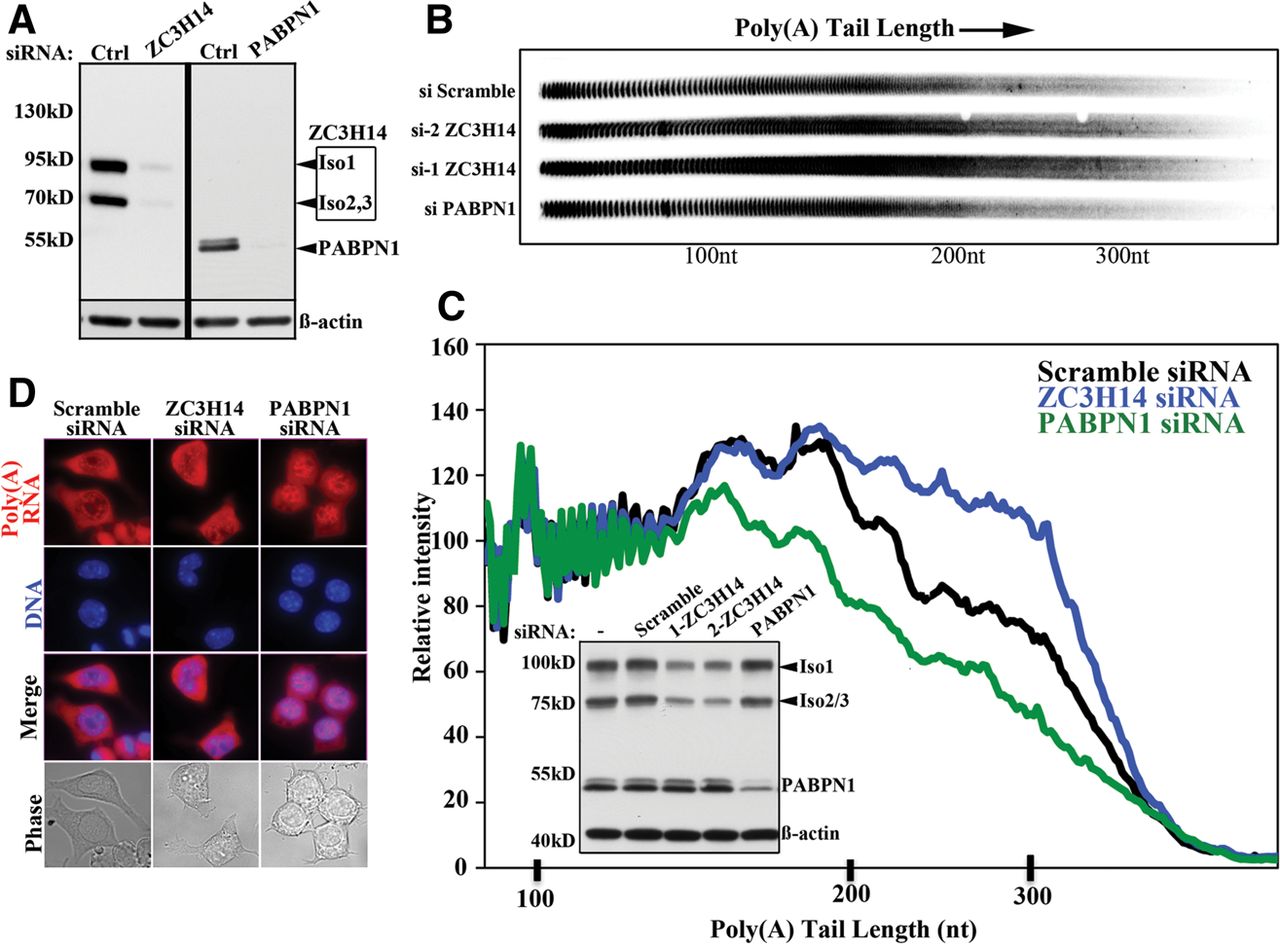
ZC3H14 is required for proper poly(A) tail length control. (A) An immunoblot shows that both ZC3H14 (isoforms 1–3) and a control polyadenosine RNA-binding protein, PABPN1, are robustly depleted from N2A cells by treatment with specific siRNA with no effect of a scrambled control RNA (Ctrl). ZC3H14-iso4 is not detected as the antibody was raised to the N-terminal PWI-like domain not present in isoform 4 (see Fig. 1A). The double band observed for PABPN1 is likely due to the presence of phosphorylated PABPN1. The corresponding β-actin band is shown as a loading control. (B) ZC3H14 was depleted from N2A cells using two independent siRNAs (C, inset). As controls, cells were also treated with PABPN1 siRNA to deplete PABPN1 or scrambled control siRNA (siScramble). Total RNA samples were prepared and subjected to bulk poly(A) tail length analysis as described in Materials and Methods. A gel of the resolved bulk poly(A) samples is shown. Approximate positions of nucleotide size markers (nt) are indicated. (C) To provide a measure of poly(A) tail length, the length of each lane of an independent poly(A) tail length assay was scanned for N2A samples treated with Control scramble siRNA, ZC3H14 siRNA, or PABPN1 siRNA as indicated. The relative intensity of the signal is plotted vs. poly(A) tail length as determined by size markers. The positions on the scan corresponding to 100, 200, and 300 nt are indicated. (Inset) An immunoblot shows the level of ZC3H14 (isoforms 1–3) knockdown obtained with two independent siRNAs for this experiment. The knockdown obtained for the control polyadenosine RNA-binding protein, PABPN1, is also shown. No treatment (−) or a control Scramble siRNA has no effect on levels of ZC3H14 or PABPN1. β-actin serves as a loading control. (D) The siRNA-treated samples shown in the inset in C were used for fluorescence in situ hybridization to assess poly(A) RNA localization. Total poly(A) RNA is visualized with an oligo dT probe. The corresponding DAPI and phase images are shown. Representative cell fields are shown. Results are typical of more than 50 cells analyzed for each siRNA where the distribution of poly(A) RNA in cells treated with ZC3H14 siRNA was indistinguishable from cells treated with scramble control siRNA.




