


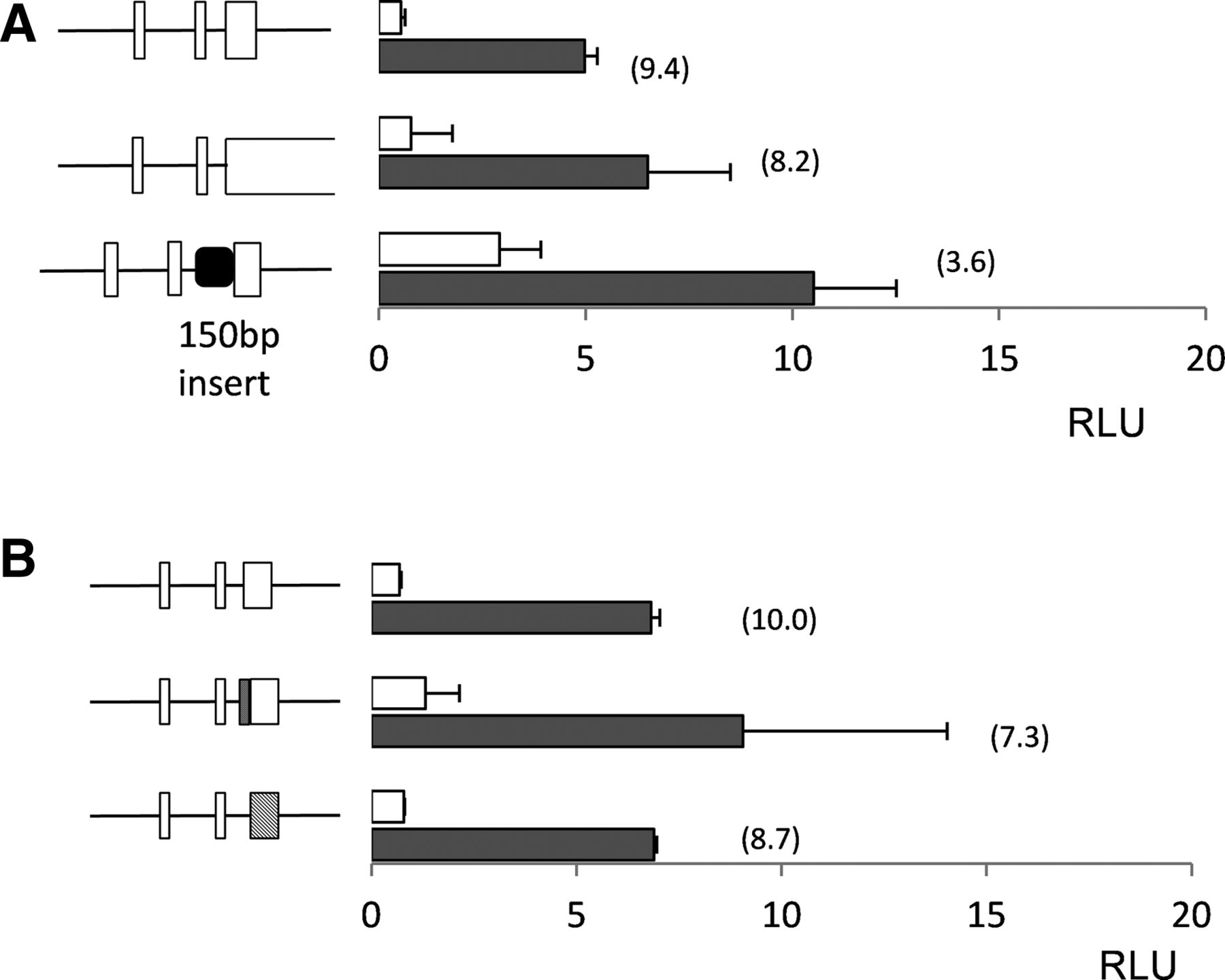
Regulation of GCN4 expression. (A) Extensive overlap between uORF3 and GCN4 coding sequences has little effect on GCN4 expression. The uORF3 stop codon and a subsequent in-frame stop codon were removed. This creates an extended 67-codon version of uORF3 that terminates 30 nt downstream from the start codon of GCN4. Increasing the spacing between uORF2 and uORF3 does not reduce GCN4 expression under starvation conditions. A 150-nt sequence, normally found between uORF3 and GCN4, was inserted between uORF2 and uORF3 as indicated. (B) The start codon context of uORF3 is not important for GCN4 translational control. The start codon context of uORF3 (GTTAAAATGG) was changed to more closely match the Kozak consensus sequence (GCCACCATGG), indicated as a shaded box in the schematic. The coding sequence of uORF3 is not important for GCN4 translational control. The peptide sequence encoded by uORF3 (MVSPLLLLLLLP) was changed (MAVPFTTAFATT), indicated as a hatched box in the schematic. White-colored bars denote values obtained from nonstressed cells; black-colored bars, values obtained from cells treated with 15 mM 3AT for 3 h.




