


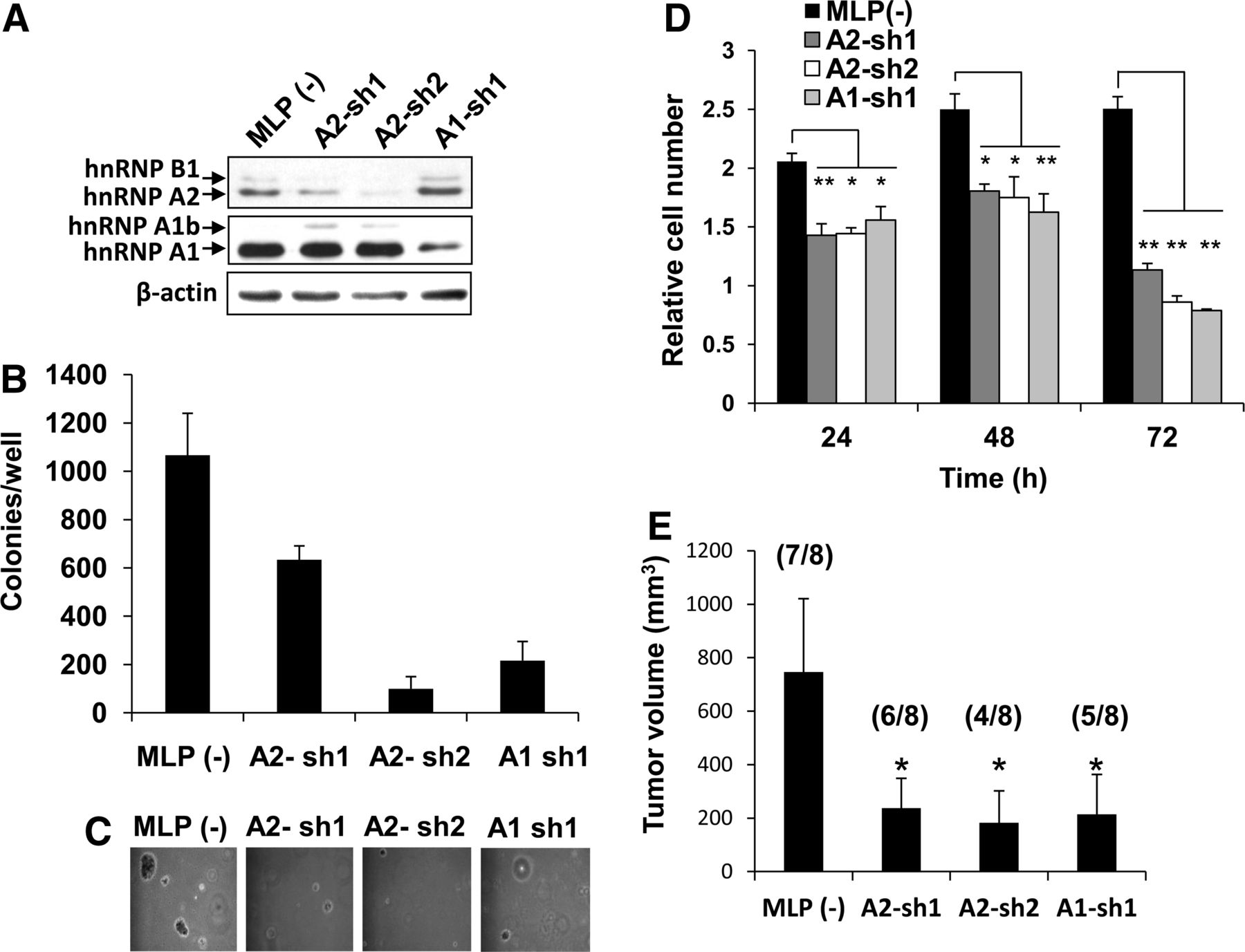
hnRNP A2/B1 and hnRNP A1/A1b are required for HCC transformation. (A) HuH7 cells were transduced with retroviruses encoding shRNAs against hnRNP A1/A1b, hnRNP A2/B1, or empty vector without the shRNA (MLP). Cells were analyzed by Western blotting for hnRNP A1/A1b and hnRNP A2/B1 protein expression. β-Actin was used as a loading control. (B) Cells described in A were seeded into soft agar in duplicate, and colonies were grown for 14 d. Colonies in 10 fields of each well were counted (mean ± SEM; n = 2). (C) Representative fields of colonies in soft agar described in B. (D) Cells described in A were starved (0.1% serum), and survival of cells was measured by methylene blue staining (mean ± SEM; n = 6). (*) P < 0.05, (**) P < 0.001 (two-tailed t-test). (E) Cells described in A were injected (2 × 10⁶ cells/site) subcutaneously near both rear flanks of SCID mice, and a graph depicting tumor growth 29 d after injection is shown. The number of tumors formed per number of injections is shown in parentheses (mean ± SEM; n = 8). (*) P < 0.05 (one-tailed t-test).




