


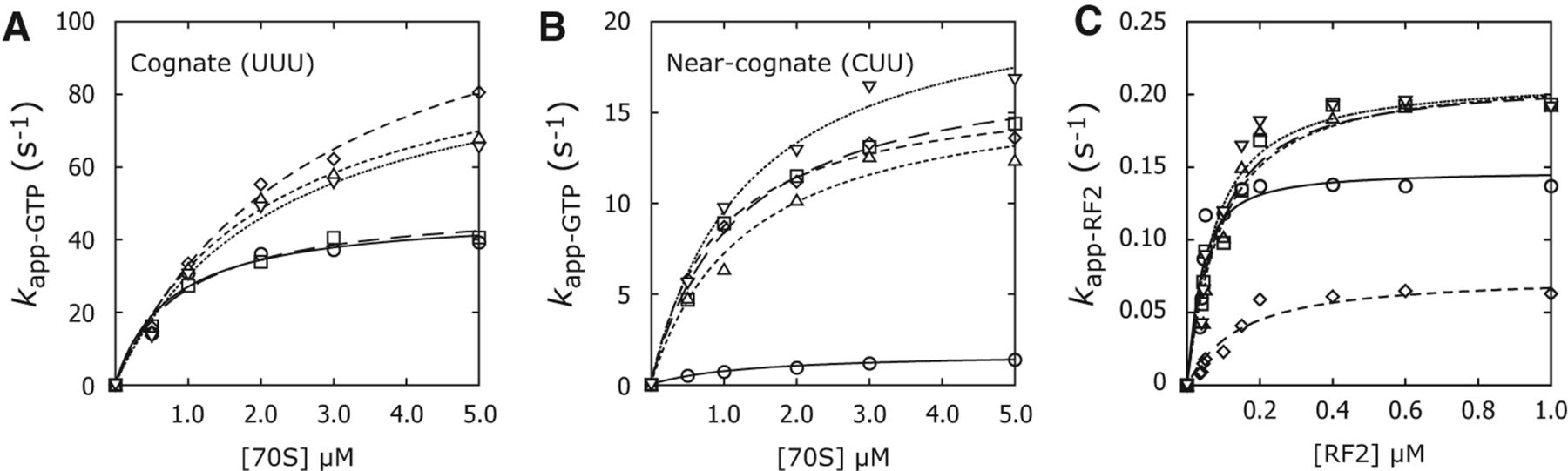
Effects of 16S A-site mutations on EF-Tu-dependent GTP hydrolysis and RF2-dependent termination. (A,B) 70S initiation complexes (70SIC) programmed with either cognate UUU or near-cognate CUU in the A site were rapidly mixed with EF-Tu•[γ32P]GTP•Phe-tRNAPhe, and rates of GTP hydrolysis were determined. Shown are apparent rates for cognate (A) and near-cognate (B) reactions plotted vs. 70SIC concentration. Data were fit to the equation kapp = kcat[70SIC]/(KM+[70SIC]), yielding the kinetic parameters shown in Table 1. (C) Ribosomes (0.2 µM) containing Ac[35S]Met-tRNAMet in the P site and codon UAA in the A site were rapidly mixed with RF2, and rates of Ac[35S]Met-tRNAMet hydrolysis were determined. Shown are apparent rates plotted as a function of RF2 concentration. Data were fit to the quadratic equation kapp = kcat{(A + B + KM) – [(A + B + KM)2 – 4AB]1/2}/(2A), where A and B represent the total concentrations of ribosomal complex and RF2, respectively, in the reaction. This yielded the kcat and KM parameters shown in Table 2. Control, ○ and solid lines; C1054U, □ and long-dashed lines; C1054A, ⋄ and medium-dashed lines; C1200U, △ and short-dashed lines; G1491A, ▽ and dotted lines.




