


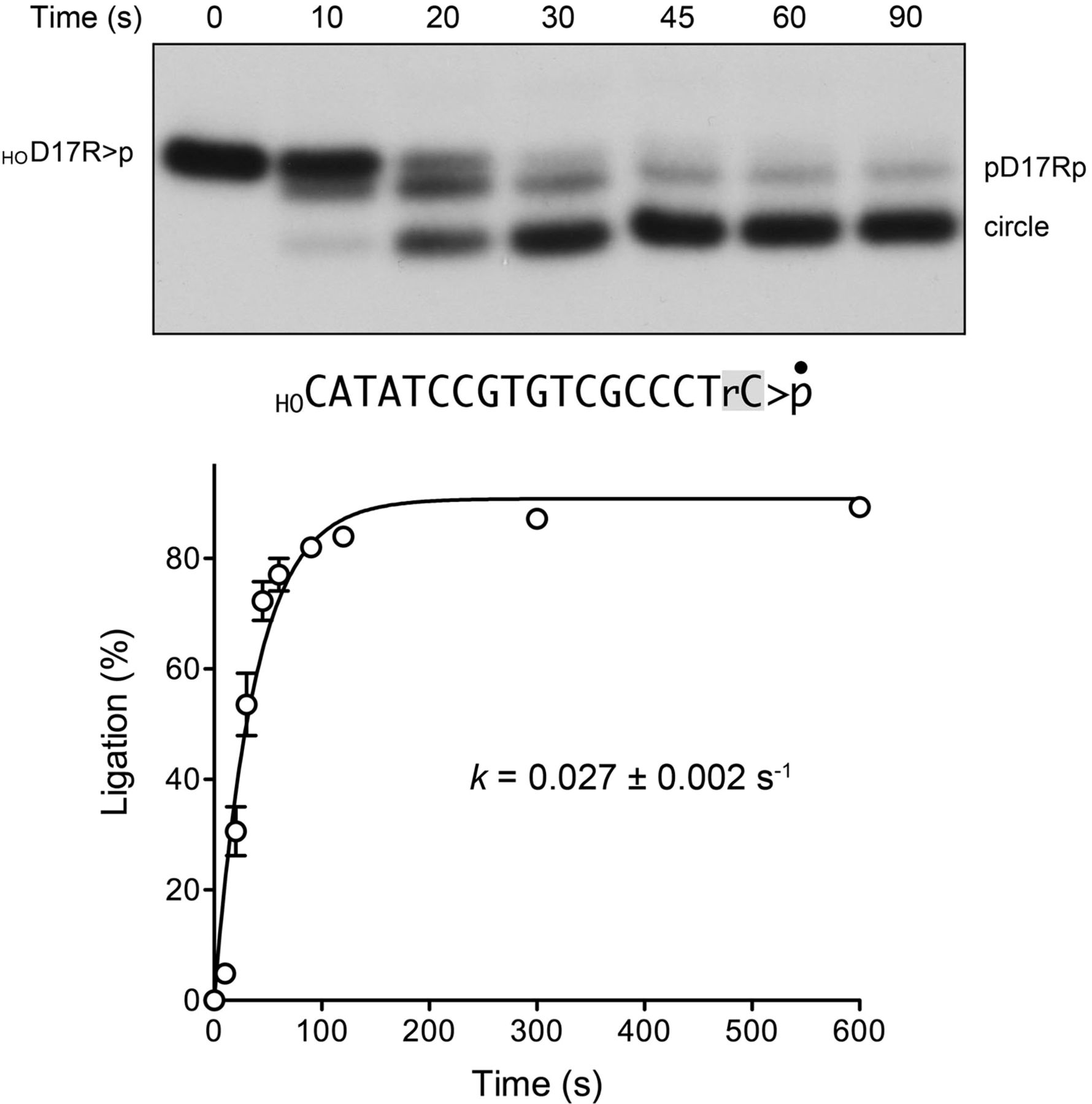
AtRNL efficiently splices a 5′-OH DNA with a ribonucleoside-2′,3′-cyclic-PO4 terminus. A reaction mixture (160 µL) containing 50 mM Tris-HCl, pH 8.0, 50 mM NaCl, 2 mM DTT, 2 mM MnCl2, 100 µM ATP, 1 µM AtRNL, and 20 nM 3′ 32P-labeled 18-mer HOD17Rp substrate (shown with the 3′ ribonucleoside shaded and the 32P-label denoted by •) was incubated at 22°C. Aliquots (20 µL) were withdrawn at the times specified and quenched immediately with an equal volume of 90% formamide, 30 mM EDTA. The time 0 sample was withdrawn and quenched prior to adding AtRNL. The products were analyzed by urea-PAGE. An autoradiograph of the gel is shown in the top panel. The position of the linear substrate (HOD17R>p) is indicated on the left; the positions of the healed intermediate (pD17R2′p) and the ligated circle product are indicated on the right. The kinetic profile of the intramolecular end joining reaction is plotted in the bottom panel. Each datum in the graph is the average of three separate experiments ±SEM. A nonlinear regression curve fit of the data to a single exponential is shown.




