


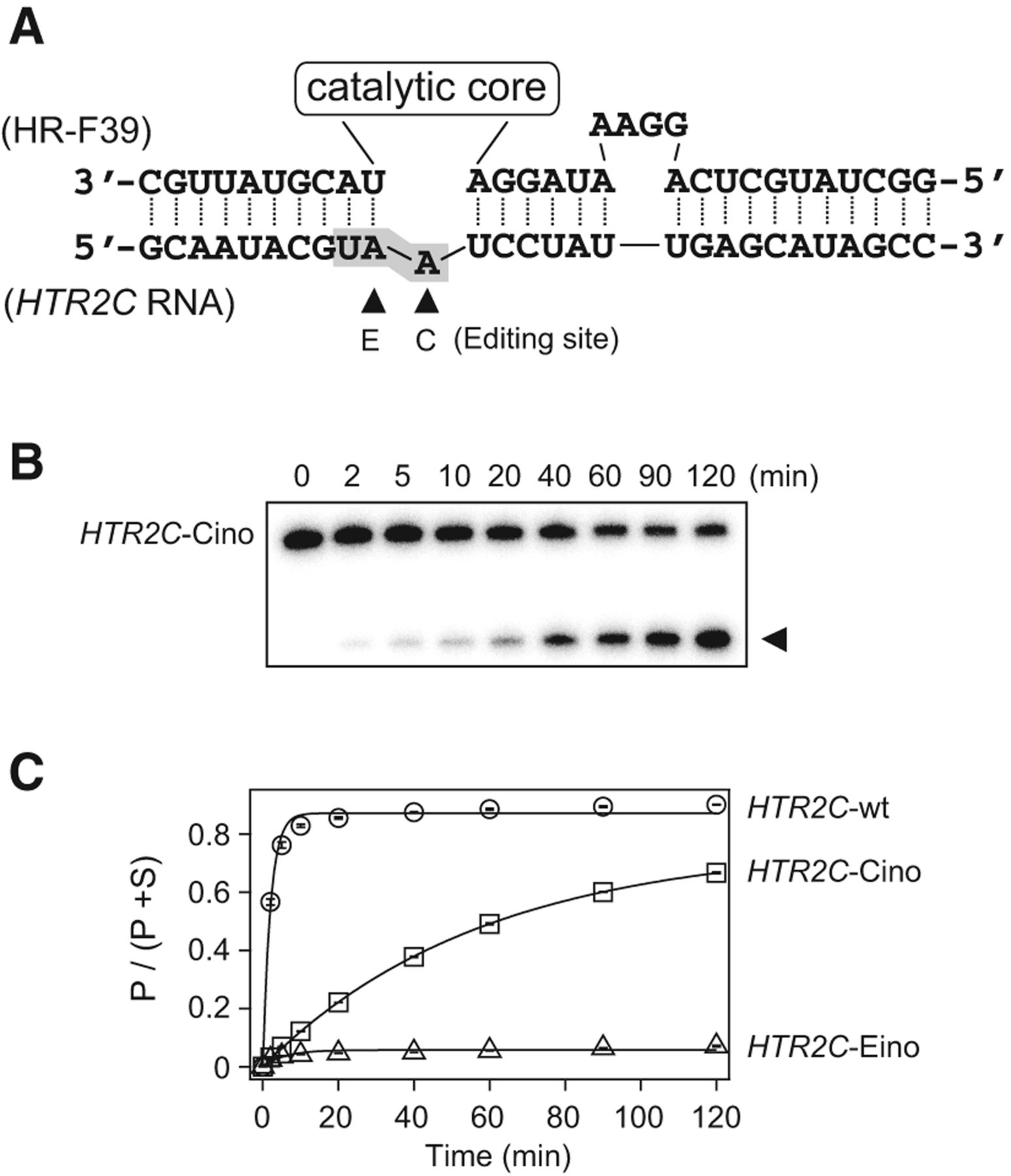
Analysis of the cleavage characteristics of HR-F39 for the HTR2C RNA fragment depending on the editing state at the second H position. (A) Sequence of HR-F39 and part of HTR2C-wt. The nucleotides corresponding to the NHH triplet are indicated in gray. The E and C sites are indicated as black arrowheads. Sequence of the catalytic core including the stem–loop II is 5′-CUGACGAGGCCUCCUACGGCCGAA-3′ as shown in Figure 2C. HTR2C-wt edited at the C site is represented as HTR2C-Cino. (B) Cleavage assay for cleavage specificity of HR-F39 at the second H position. Denaturing PAGE (15%) shows the cleavage activity of HR-F39 for HTR2C-Cino. Positions of the uncleaved substrate and the resulting 5′-cleavage products are indicated. (C) Summary of the cleavage characteristics of HR-F39 for HTR2C RNA fragments that are edited at the first or the second H position. The graph represents the cleavage ratio of HR-F39/HTR2C RNA as a function of reaction time. The data for HTR2C RNAs are represented as circles (HTR2C-wt), triangles (HTR2C-Eino), and squares (HTR2C-Cino). The data from HTR2C-wt and HTR2C-Eino are the same in Figure 3B. All data were obtained from two independent experiments for reproducibility. Fitting curves were generated using a single-exponential equation. Kinetic parameters obtained from this experiment are summarized in Table 1.




