


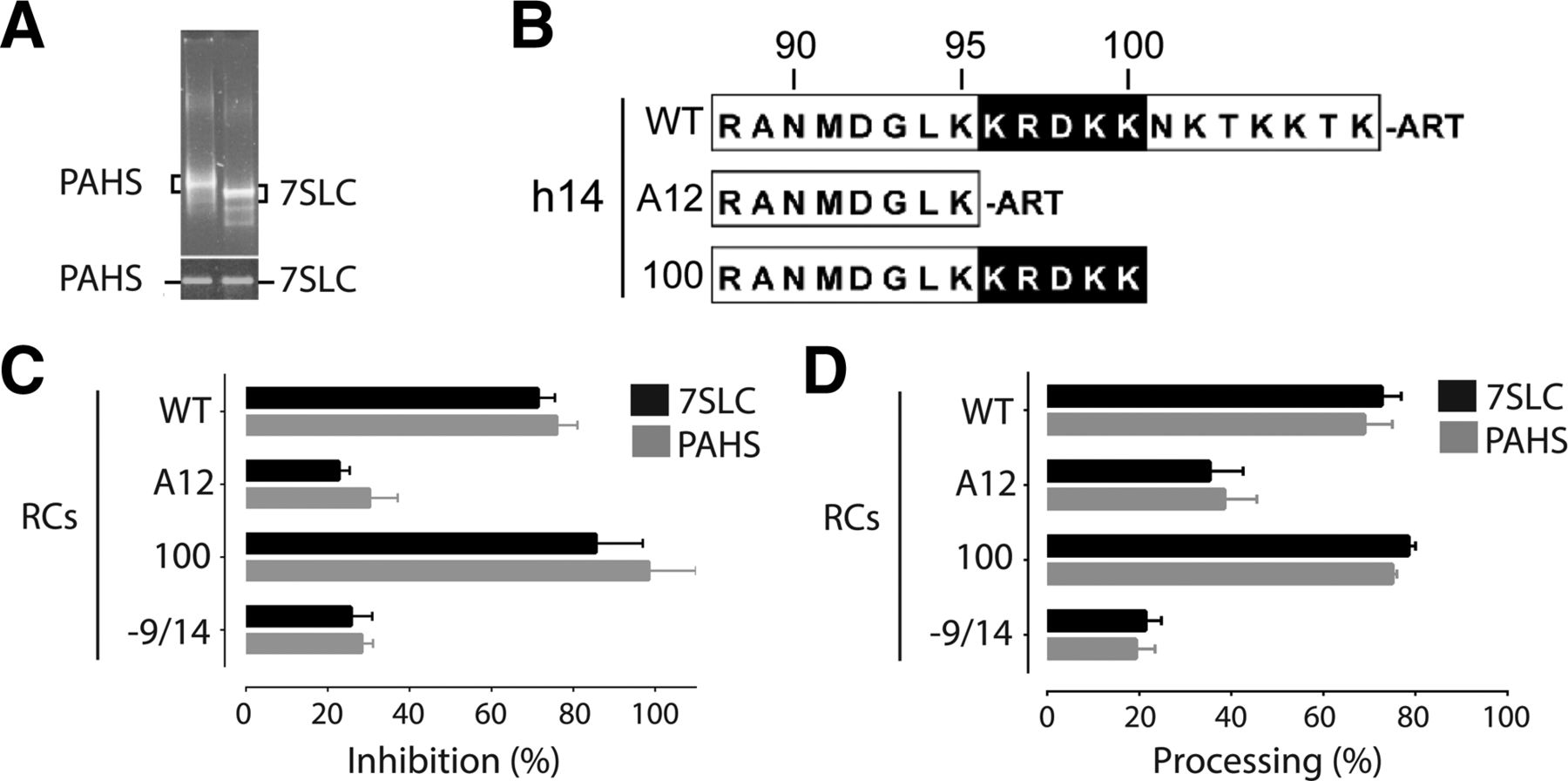
Functional analysis of reconstituted SRPs comprising the chimeric human/archaeal SRP RNA PAHS. (A) Ethidium bromide-stained gels of 7SLC and PAHS RNAs displayed by native (upper panel) and denaturing (lower panel) PAGE. (B) C-terminal sequences of human SRP14 (h14) proteins used in the functional assays are shown; residue numbers are indicated above. The alanine-rich tail is indicated as ART, for brevity. The sequence known to be essential for elongation arrest activity is shown in white letters on a black background. In h14A12 the basic pentapeptide K96–K100 is removed whereas it is present in h14-100. (C) and (D) Reconstitution reactions were added to translation reactions at a final concentration of 100 nM. The translation products were displayed by SDS-PAGE and quantified by phosphor-imager (Supplemental Fig. 4B,C). Elongation arrest activity (C) was determined as the relative inhibition in preprolactin synthesis as compared with cyclin synthesis. The translocation assays contained salt-washed canine microsomes at 0.02 eq/µL. The translocation efficiency (D) is determined as the percentage of total preprolactin processed into prolactin (Mary et al. 2010). Standard errors of the mean are shown as SEM (n ≥ 2). SRP was reconstituted with either 7SLC (black bars) or PAHS RNA (gray bars) together with recombinant (SRP19, SRP54) and canine (SRP68/72) proteins as well as the SRP9/14 proteins indicated. WT: SRP9/14; −9/14: without SRP9/14.




