


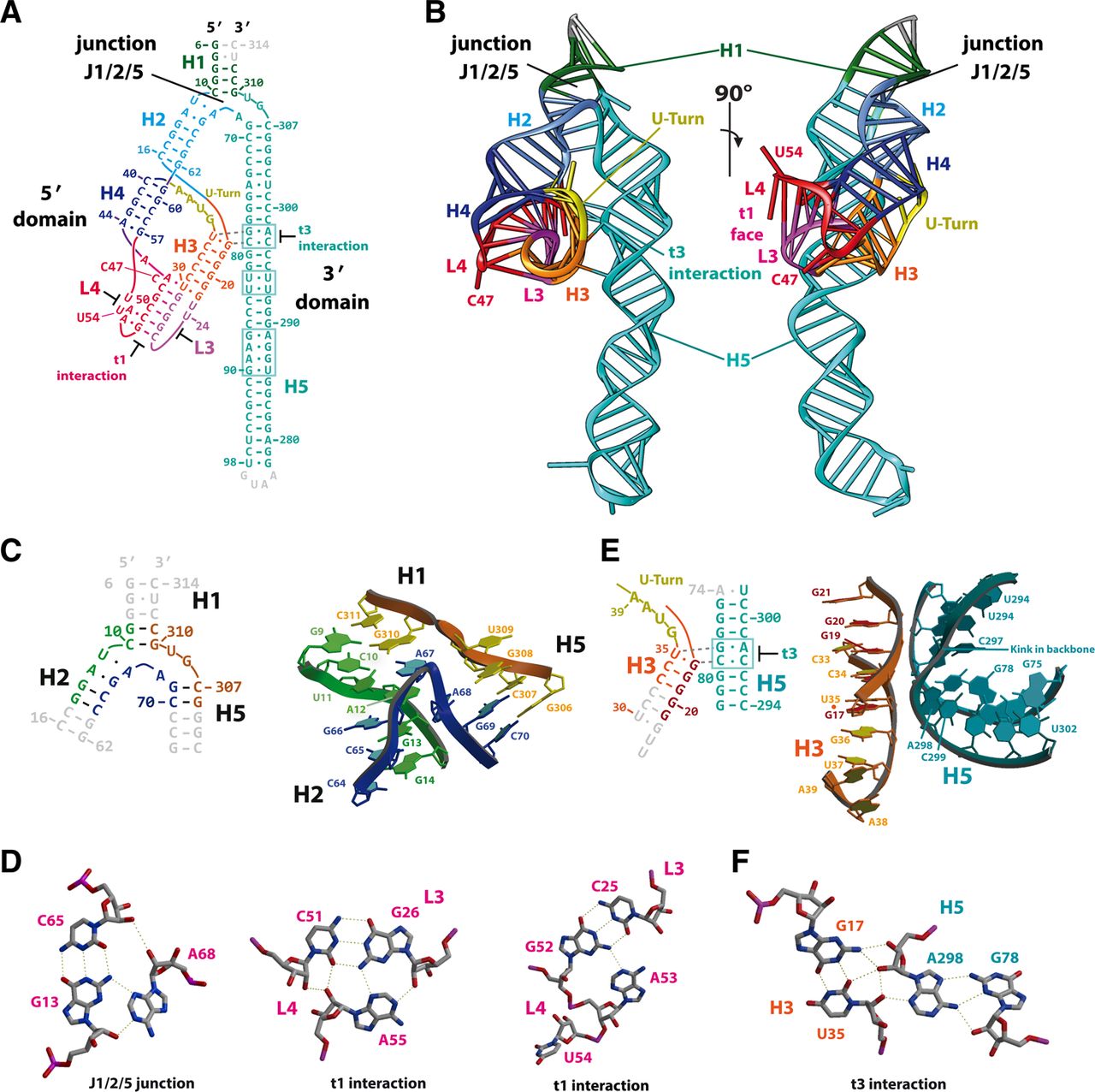
Structure of the PhAlu134 RNA. (A) Structure based secondary structure of the PhAlu134 RNA. SRP secondary and tertiary structural elements are labeled as recommended (Zwieb et al. 2005) as follows: helix (H), loop (L), tertiary interaction (t). Color-coding used is as follows: H1 (green), H2 (light blue), H3 (orange), H4 (blue), H5 (cyan), extra 3′ nucleotides and tetraloop (gray). Base pairs are depicted as Watson–Crick (dash), others (dot). Numbering is according to full-length P. horikoshii SRP RNA (http://rnp.uthscsa.edu/rnp/SRPDB/rna/srprnaphylolist_arch.html). (B) Cartoon representation of the structure of the PhAlu134 SRP RNA with SRP9/14 proteins removed for clarity. Color-coding and labeling used are as in A. At the surface of the tertiary interaction t1, a flat “face” is formed by base triples, and C47 and U54 are flipped out into the solvent. (C) Details of the three-way junction between H1, H2, and H5 (J1/2/5). (Left) Schematic of the junction. Residues G9–G14 (from helix 1 to 2) are shown in green, C64–C70 (helices 2–5) are shown in blue, and residues G306–C311 (helices 5–1) are in orange. (Right) The RNA backbone (ribbon) and bases are color-coded as on the left. Interactions around A67 and A68 stabilize the junction, whereas these bases would form a flexible hinge in the human counterpart structure. (D) Stabilization of the structure by base triples shown in stick representation. (Left) G13–C65–68 base triple in the J1/2/5 junction. (Center and right) Base triples reinforce the L3–L4 tertiary interaction (t1). Interloop base pairs C51·G26 and G52·C25 form A-minor motif base triples with A55 and A53, respectively. (E) The t3 tertiary interaction between the 5′ and 3′ domains. (Left) Schematic of the t3 stem–stem interaction drawn as in C. (Right) The H5 backbone is distorted by noncanonical base pairs to permit close packing of the two stems. (F) The universally conserved G17·U35 wobble base pair of helix 3 interacts with A298 of helix 5. A298 and G78 interact in turn via a sheared base pair at a position that in many other species is an asymmetric internal loop of helix 5.




