


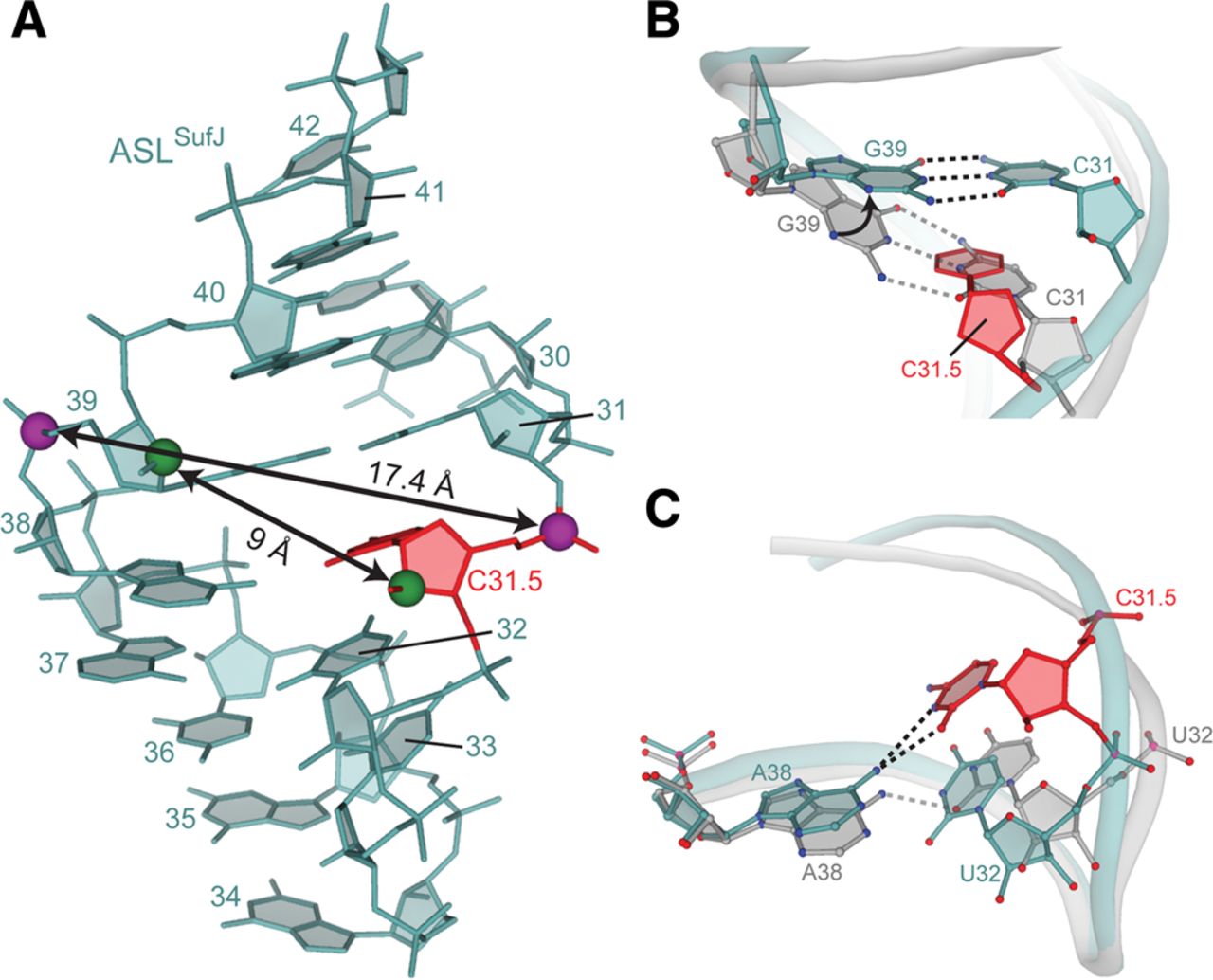
Narrowing of ASLSufJ alters anticodon stem base-pair interactions. (A) Both the major (as measured by C31.5·G39 phosphate–phosphate distances; purple spheres) and minor grooves (as measured by C31.5·G39 C2′–C2′ distances; green spheres) are narrowed in ASLSufJ as compared with canonical major and minor groove distances of 18.4 Å and 14.2 Å, respectively (e.g., ASLThr). The C31.5 insertion is shown as red. (B) The C31.5 insertion (red) causes C31 in ASLSufJ (blue) to shift in the 5′ direction; however, the interaction with G39 (blue) is maintained via a 25° rotation of its base around the glycosidic bond. The canonical C31–G39 interaction of a canonical seven-nucleotide ASLThr is shown for comparison (gray). (C) The 5′ phosphate backbone movement shifts U32 (blue) closer to the opposite RNA stem while A38 rotates 8° to form a bifurcated hydrogen bond with the inserted C31.5 (red). This new interaction prevents the formation of the conserved U32·A38 base pair of ASLThr (gray).




