


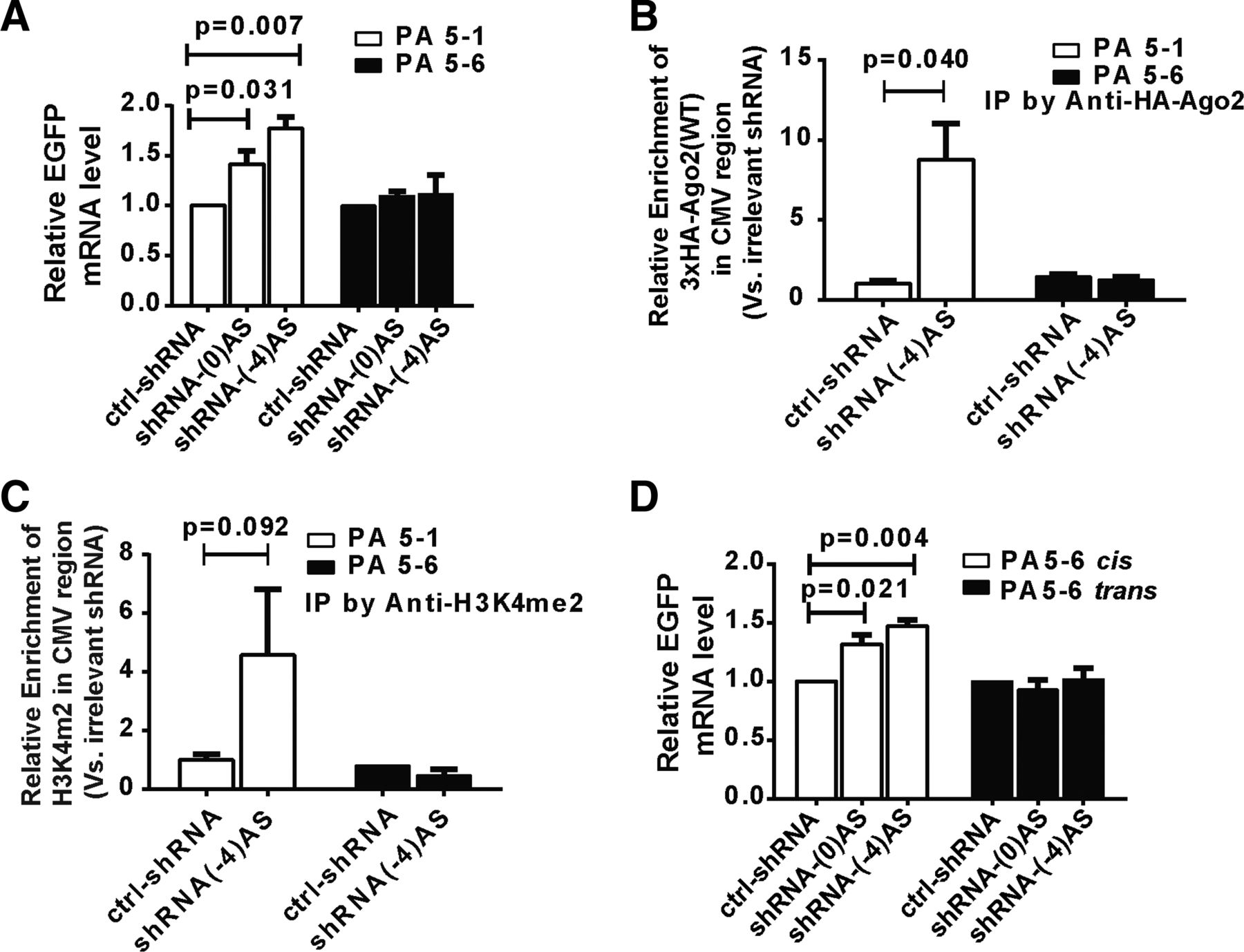
Nascent promoter-associated antisense lncRNAs are required for shRNA-triggered TGA. (A) qRT-PCR was used to measure eGFP mRNA in clones PA5-1 and PA5-6 4 d after treatment with irrelevant shRNA (ctrl-shRNA) or TGA-inducing shRNAs (shRNA-(0)AS and shRNA-(-4)AS). Both clones are derived from clone PA5 and share the same integration site, but clone PA5-6 has an inverted poly(A) sequence designed of the nascent antisense RNA. Statistical analysis in this study was performed using a two-tailed t-test. (B) ChIP analysis of Ago2 recruitment to the CMV promoter for clones PA5-1 and PA5-6 treated with control (ctrl-shRNA) or TGA-inducing [shRNA-(-4)AS] shRNA. Immunoprecipitated genomic DNA was quantified by qPCR. In this study, all experiments were repeated three times independently and data are represented as mean ± SD. (C) ChIP analysis of epigenetic marker H3K4me2 at the CMV promoter for clones PA5-1 and PA5-6 treated with control (ctrl-shRNA) or TGA-inducing [shRNA-(-4)AS] shRNA. Immunoprecipitated genomic DNA was quantified by qPCR. In this study, all experiments were repeated three times independently and data are represented as mean ± SD. (D) Rescue of TGA phenotype in clone PA5-6. qRT-PCR was used to measure eGFP mRNA in clones PA5-6 after rescue using Tat-NLS-Cre recombinant protein (white bars) to restore the cis-acting function of the antisense lncRNA. The trans-acting function of antisense lncRNA was by ectopic expression of CMV antisense lncRNA (black bars).




