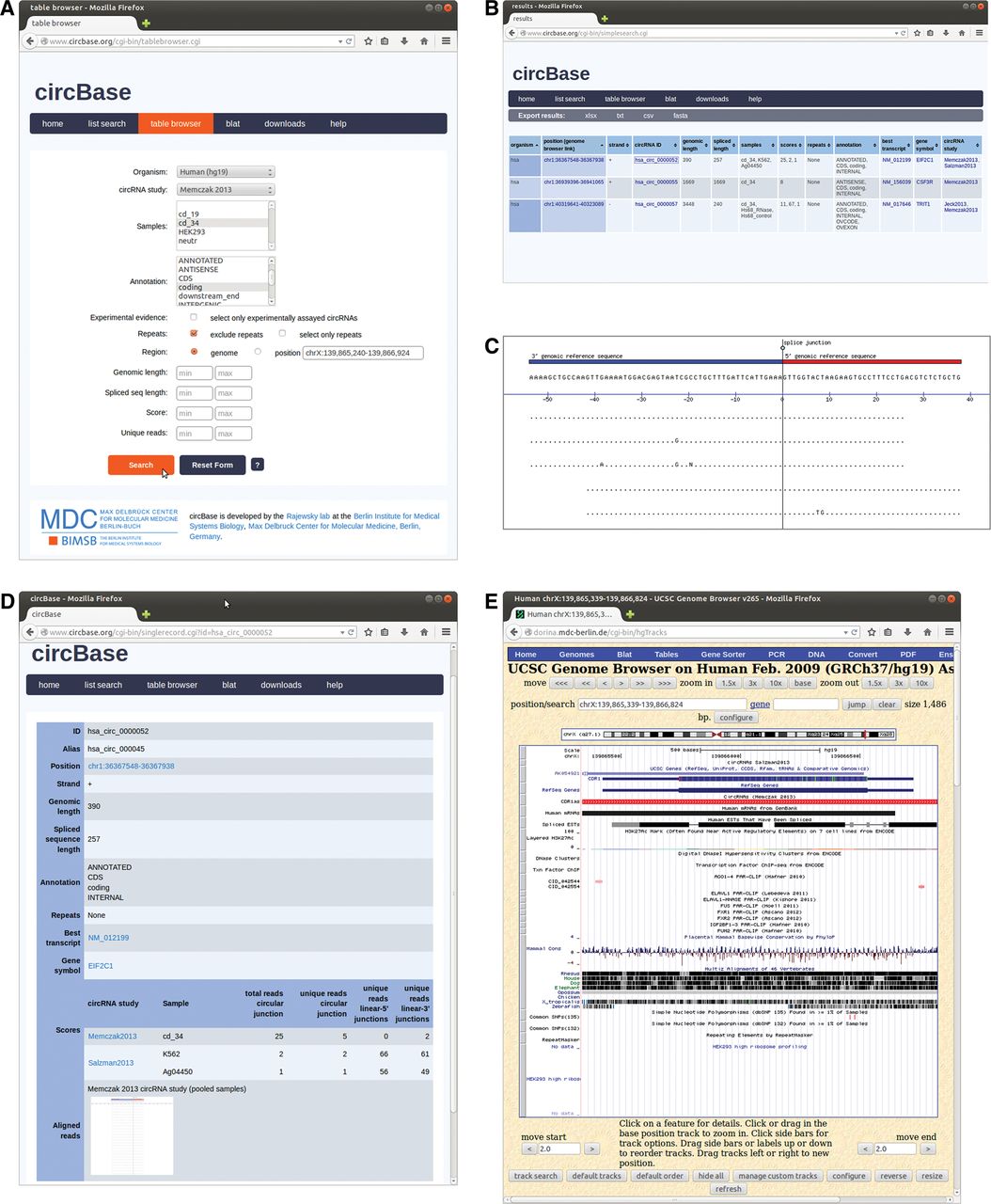
(A) circBase table browser. Table browser enables the user to design queries for conditional data retrieval. In this example, the user will retrieve all circRNAs from a CD34+ sample, 100–500 nt in length, that are transcribed from coding regions and do not overlap repeat sequences. (B) circBase results page. The user is presented with basic information about each circRNA that matched the search query. Columns, from left to right, contain information on the following: (1) the organism data came from; (2) genomic position; (3) the strand circRNA is transcribed from; (4) a unique identifier; (5) genomic length; (6) length of an in silico predicted spliced form; (7) list of samples the circRNA was observed in; (8) number of reads overlapping the circular junction; (9) repeat sequences overlapping the 3′ and 5′ ends that give rise to a head-to-tail splice junction; (10) circRNA annotation (annotation terms are described in documentation available on the circBase website); (11) an overlapping transcript; (12) gene symbol of the overlapping gene; and (13) a list of studies in which the particular circRNA was detected. (C) Reads mapped to a head-to-tail splice junction. Alignments of reads that support a head-to-tail splice junction can be retrieved from a single record page. Nucleotides that match the genomic reference are printed as dots, while mismatched nucleotides are represented as letters. (D) circBase single record page. In addition to data available from a results page, the user can explore more information about a particular circRNA on a single record page. (E) UCSC genome browser on doRiNA, a database for post-transcriptional regulatory elements. A region surrounding the CDR1as circRNA is shown. In addition to the basic genome browser tracks, the user can explore RNA binding protein PAR-CLIP tracks, ribosome profiling data, miRNA target prediction tracks, and much more.