


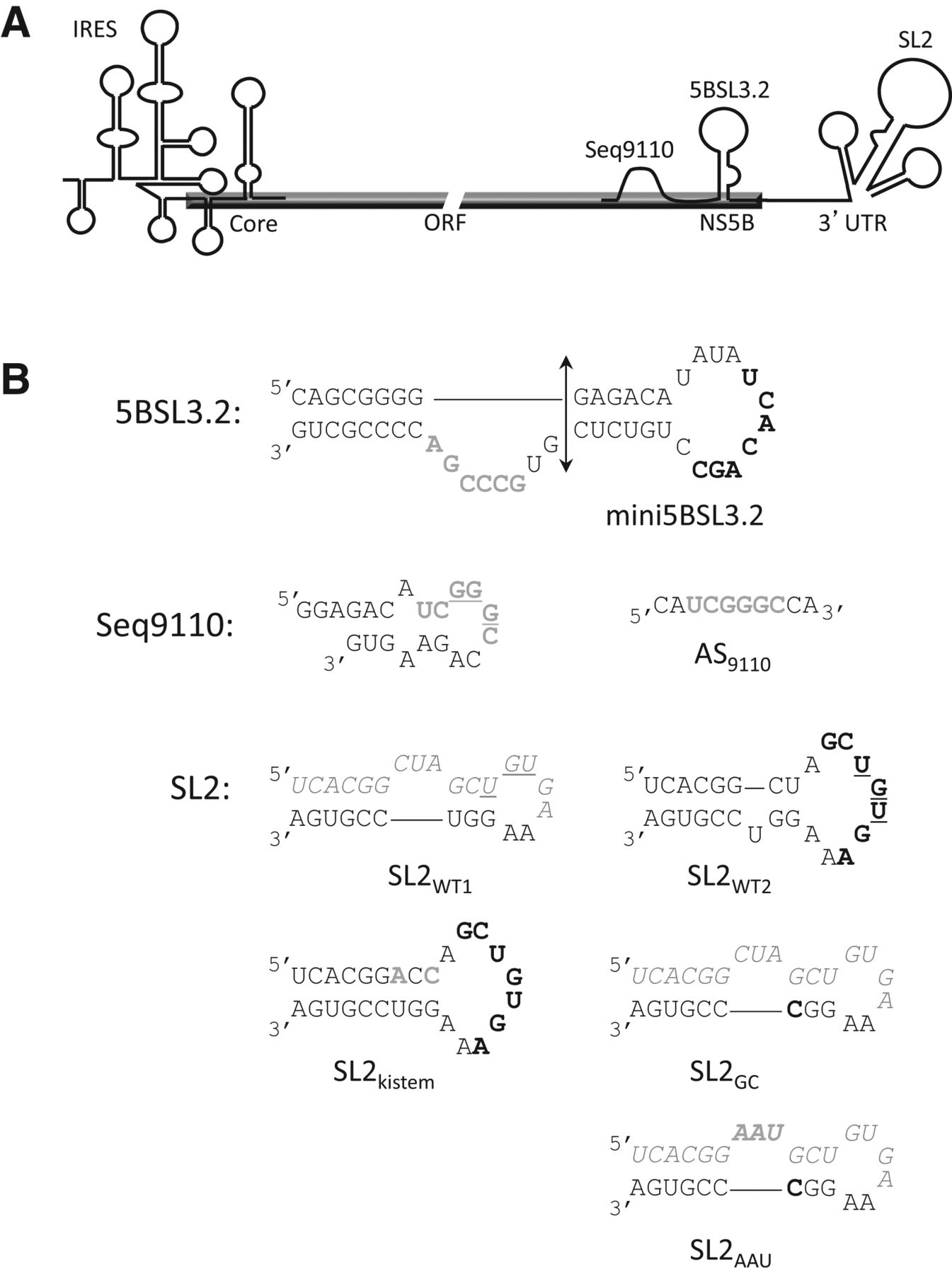
(A) Scheme of the HCV genome. The internal ribosome entry site (IRES) is on the 5′ side. The SL2 stem–loop is located in the 3′ UTR region. Seq9110 and 5BSL3.2 are located in the region coding for the NS5B protein. The region coding for the core protein (Core) is also shown. (B) Sequences and secondary structures of the RNAs. 5BSL3.2 was modified with a biotin tag at the 3′ end, allowing immobilization by streptavidin-biotin coupling on the sensor chips. The sequence in bold black indicates bases that could form Watson-Crick base pairs with SL2 (also in bold black). The sequence in bold gray indicates bases that could interact with Seq9110 or AS9110 (also in bold gray). Mini5BSL3.2 is a truncated version (double arrow) of 5BSL3.2 corresponding to the perfect stem–loop above the internal loop. AS9110 is an antisense oligonucleotide derivatized from Seq9110. For SL2, the sequences in italic gray indicate the palindromic sequence of SL2. Underlined bases for SL2 and Seq9110 indicate nucleotides that were replaced to generate hairpins of decreased affinity for 5BSL3.2: UGU was replaced by ACA for SL2, and GGG by AAA for Seq9110. SL2WT1 and SL2WT2 are two predicted secondary structures of SL2 obtained from the Mfold web server (http://mfold.rna.albany.edu/?q=mfold/RNA-Folding-Form). Bases in bold gray for SL2kistem (A and C) indicate modifications that were made to convert SL2WT2 in a perfect stem–loop structure. SL2GC was designed to generate a hairpin of increased stability compared with SL2 without altering the palindromic sequence. SL2AAU is a mutated version of SL2GC in which CUA was mutated in AAU (in bold gray).




