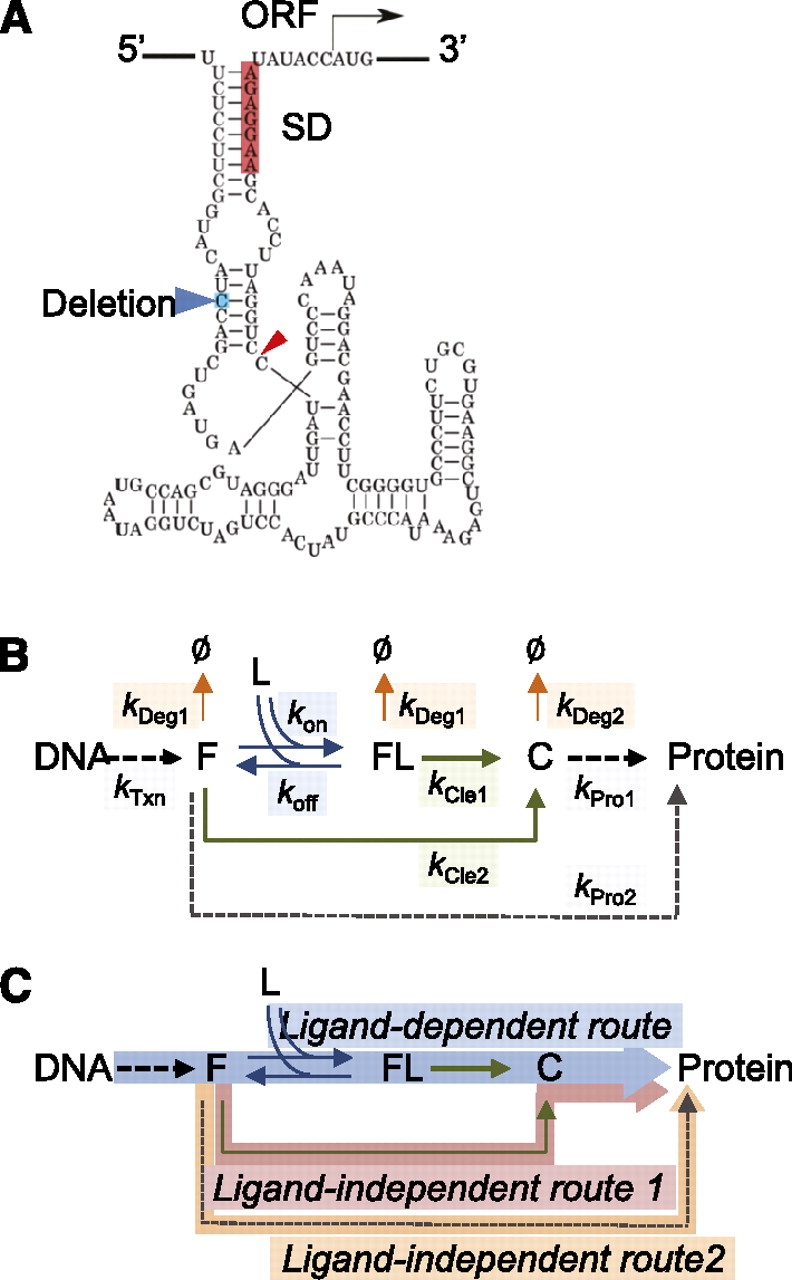
(A) TPP-responsive on-switch aptazyme developed by Wieland and coworkers. (Red highlight) The SD sequence; (red arrowhead) the self-cleavage site; (blue highlight) the deleted base of the mutant DelC. (B) Scheme of the kinetic model for switching of gene expression by an aptazyme. (DNA) DNA encoding the aptazyme and protein gene; (F) free full-length RNA; (L) ligand; (FL) ligand-bound full-length RNA; (C) cleaved RNA; (Protein) protein; (kTxn) transcription rate constant; (kon) association rate constant with ligand; (koff) dissociation constant with ligand; (kCle1) ligand-dependent self-cleavage rate constant; (kCle2) ligand-independent self-cleavage rate constant; (kPro1) translation rate constant from the cleaved RNA; (kPro2) leaky translation rate constant from the full-length RNA; (kDeg1) degradation rate constant of the full-length RNA; (kDeg2) degradation rate constant of cleaved RNA; (φ) RNA degradation. Leaky translation from ligand-bound full-length RNA (FL) was not shown in this scheme for simplicity, but this process was included in the equation (see Eq. 4 in the Supplemental Material). (C) Schematic representation of translation routes. In this model, there are three routes of protein translation: one route for ligand-dependent translation and two routes for ligand-independent translation. The ligand-dependent route is the major route of translation in the presence of ligand, depending on translation from the cleaved RNA produced by ligand-dependent self-cleavage. Ligand-independent route 1 is translation from the cleaved RNA produced by a ligand-independent process. Ligand-independent route 2 is leaky translation from the full-length RNA.