


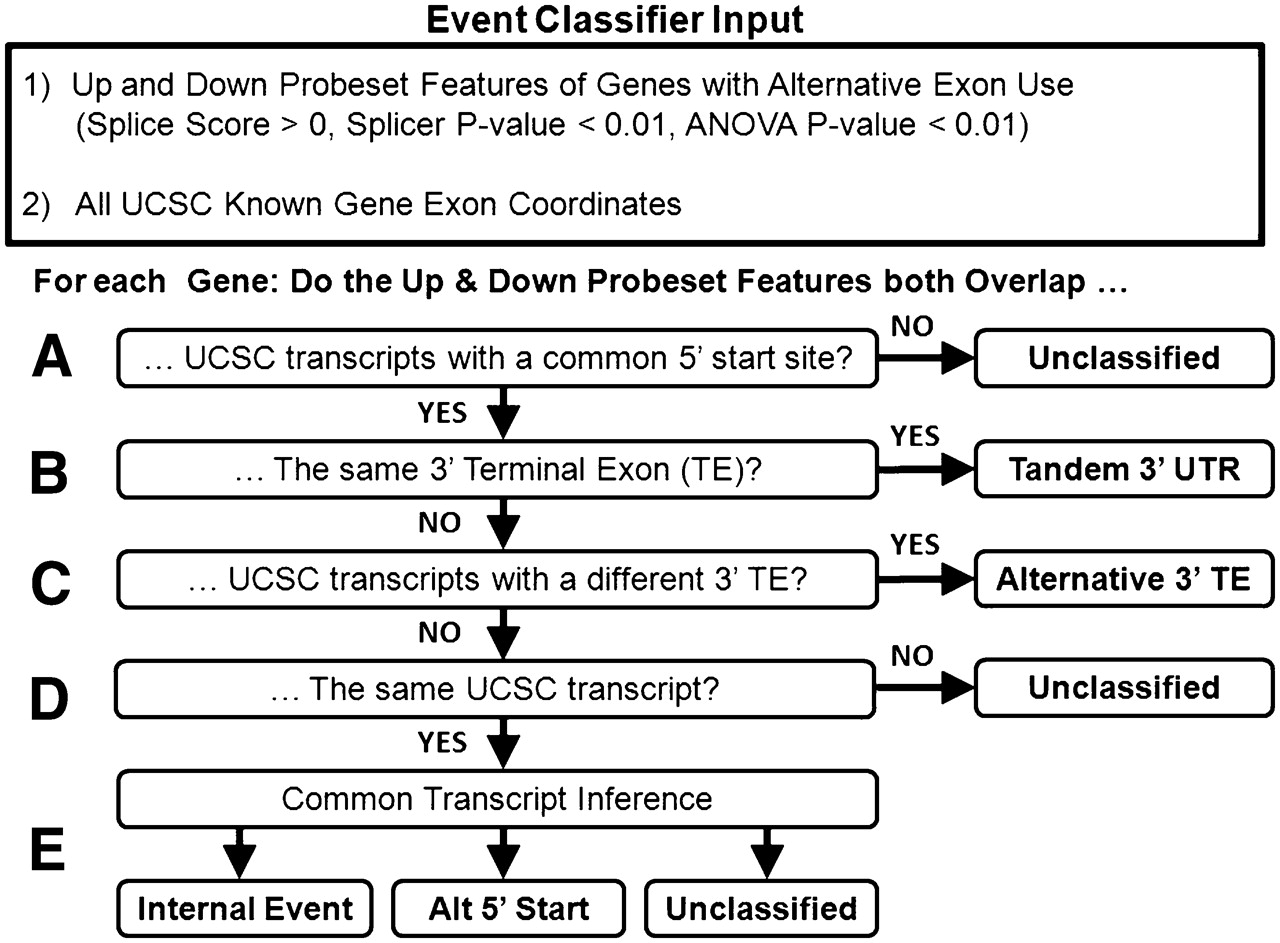
SplicerEX decision tree used to categorize alternative mRNA processing events into discrete categories. SplicerEX assigned mechanistic categories of mRNA isoform changes by comparing the location of the two primary distinguishing probe set features (probe sets for the U133 array and meta-probe sets for the HuEx arrays) with known UCSC gene transcripts. The algorithm first removes a gene if either feature does not overlap a known UCSC transcript, resulting in an unclassified event. Second, the event is recorded as unclassified if neither feature overlaps transcripts with a common 5′ start site (A). If both features overlap the same 3′-terminal exon, then the event reflects a change in 3′-UTR length, indicating the presence of tandem 3′ UTRs (B). If each feature targets a different 3′ terminal exon, then the gene is categorized as undergoing alternative 3′ terminal exon choice (C). If the event has not been categorized at this point, but both features target at least one common UCSC transcript (D), then the event is categorized as an internal event, an alternative 5′ initiation event, or unclassified using the common transcript inference (CTI) algorithm (E) (Table 2).




