


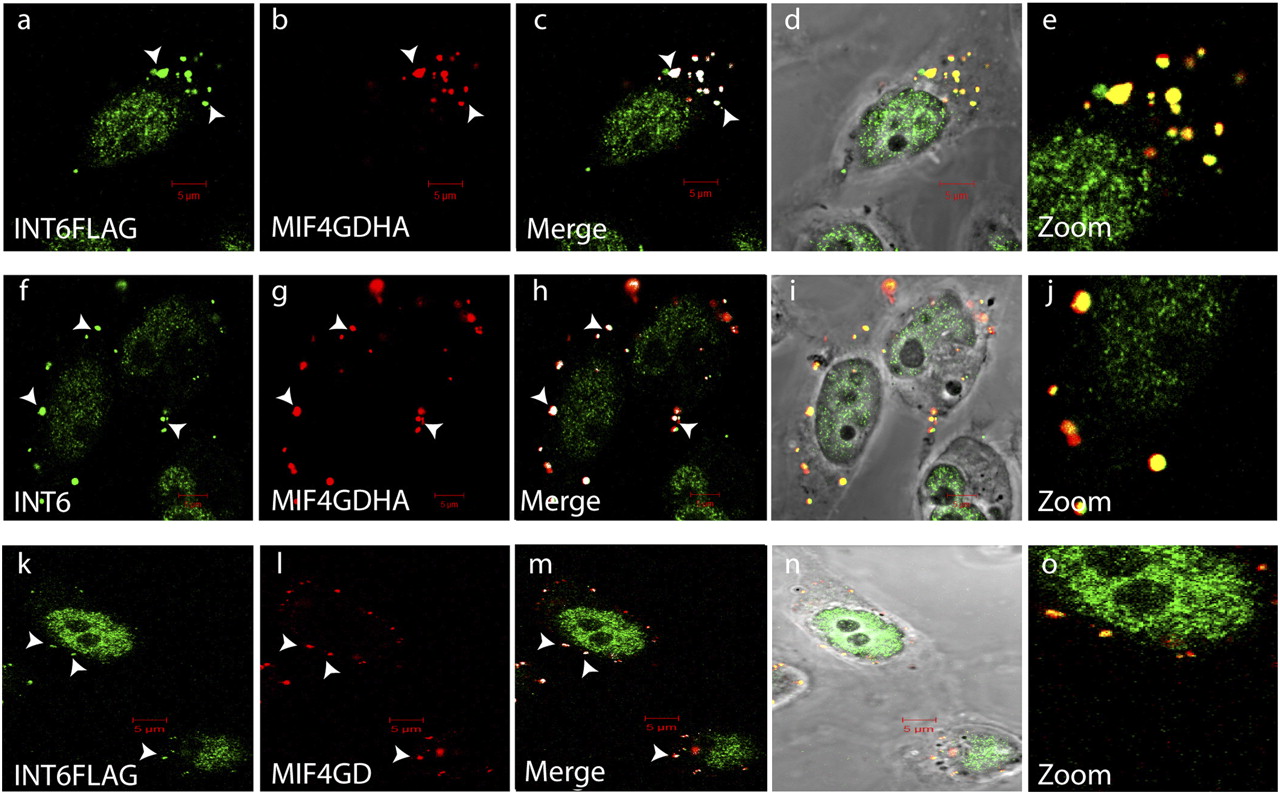
Colocalization in the cytoplasm of INT6 and MIF4GD. HeLa cells were transfected with the MIF4GDHA and INT6FLAG expression vectors in combination (panels a–e), with only the former (panels f–j), or with only the latter (panels k–o). The cells were stained with the following combination of antibodies: C-169 antibody to INT6 and monoclonal antibody to HA (panels a–j), monoclonal antibody to Flag and rabbit antiserum to MIF4GD (panels k–o). Representative confocal images are shown, as well as superimpositions of both stainings (panels c,h,m) and of the stainings with the corresponding transmission image (panels d,i,n). In panels c, h, and m, colocalization was evaluated by using the Colocalization Highlighter plug-in of ImageJ software; colocalized pixels appear in white. (White arrows) Examples of cytoplasmic foci with colocalization of INT6 and MIF4GD. An enlargement of the picture corresponding to colocalizing foci is also shown (panels e,j,o). Scale bars, 5 μm.




