


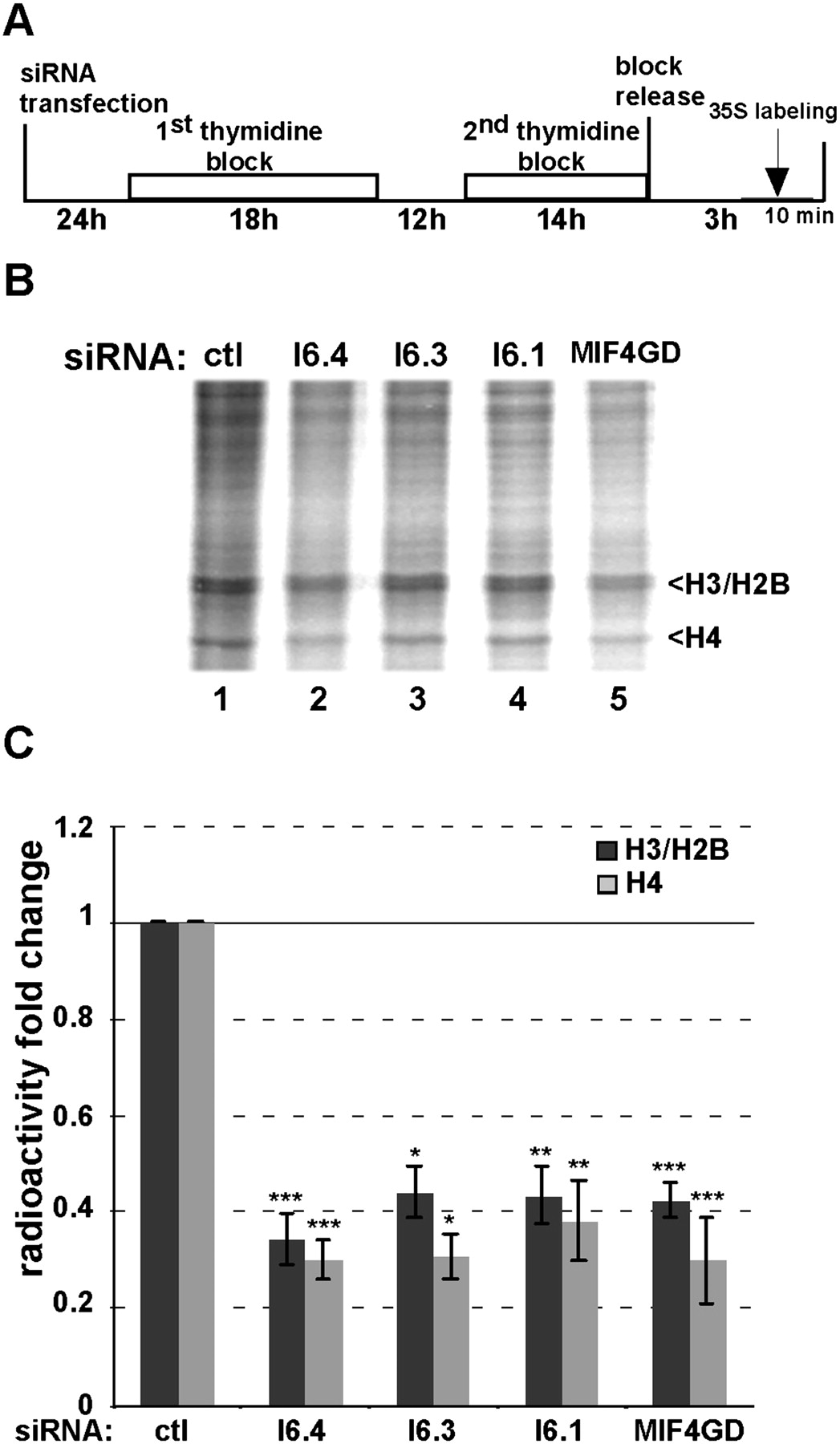
Effect of INT6 knockdown on histone protein synthesis. (A) Schematic representation of the protocol used to synchronize cells and to label histones. HeLa cells were synchronized by a double-thymidine block and released into the S phase after the second block. Cells were then pulse-labeled for 10 min with 35S-labeled methionine and cysteine. (B) HeLa cells were transfected with either control (lane 1) or three different siRNA duplexes targeting INT6 (lanes 2–4) or MIF4GD siRNAs (lane 5). The proteins obtained after acidic extraction were separated on a 15% SDS-polyacrylamide gel, and radioactivity was analyzed using a phosphorimager. The bands corresponding to histones H3, H2B, and H4 are indicated. (C) The experiment was repeated three times, and the amount of radioactivity in the H3/H2B bands as well as in the H4 band was quantified using the MultiGauge software with normalization with respect to bands of the upper part of the gels as previously described (Cakmakci et al. 2008). The mean of the ratios with respect to cells transfected with control siRNAs is represented with an error bar corresponding to the standard deviation. Data were analyzed with a Student's t-test (two-tailed, unpaired), and the stars indicate a P-value of (*) <0.05, (**) 0.01, or (***) 0.001 with respect to the control siRNA condition.




