


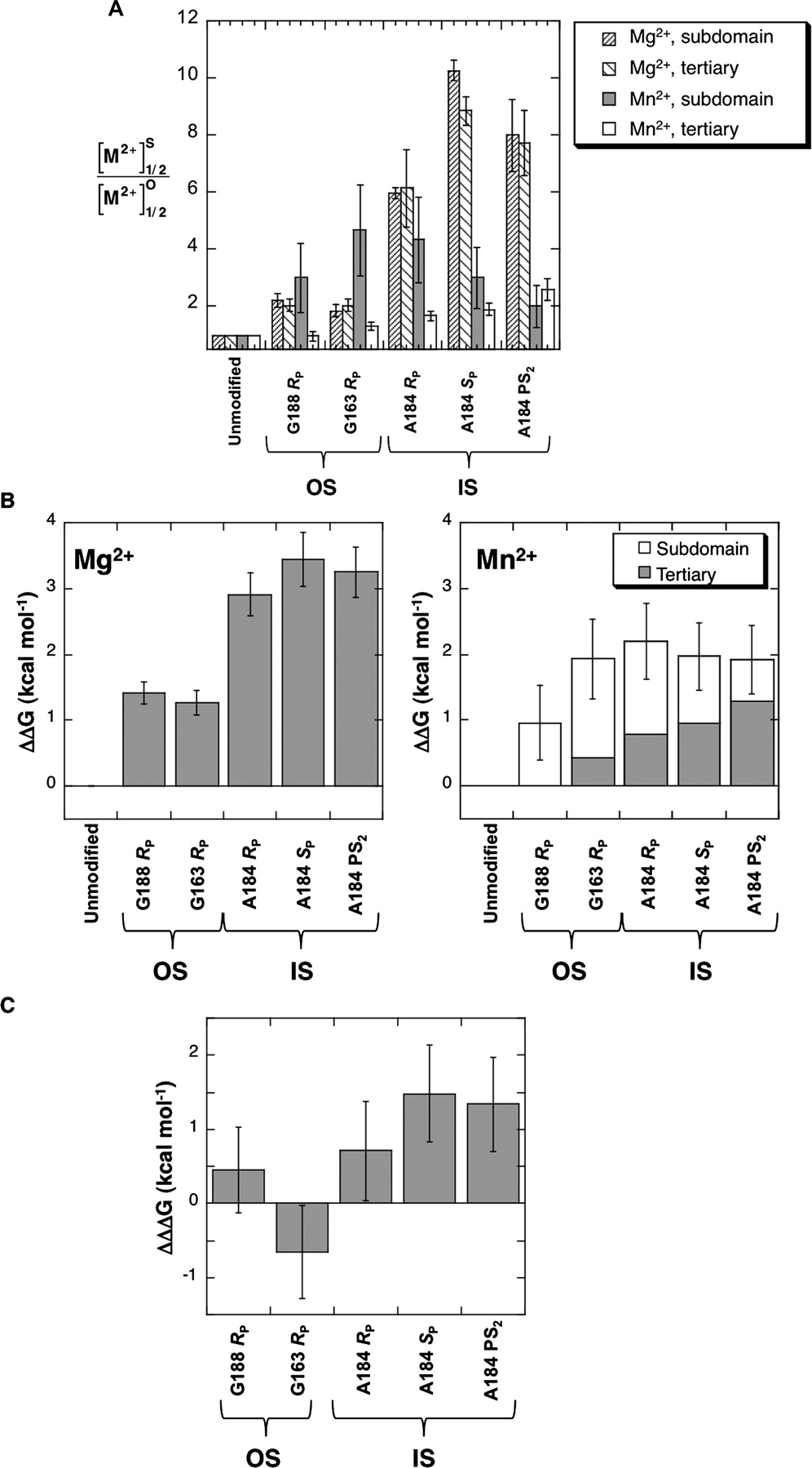
(A) Divalent metal-ion midpoint ratios of P4–P6 variants folded in either Mg2+ or Mn2+ in a background of 20 mM Na+, separated into subdomain and tertiary folding midpoints (OS: outer-sphere metal-ion ligand; IS: inner-sphere metal-ion ligand). (B) Calculated ΔΔG values (relative to unmodified P4–P6) associated with Mg2+-induced (left) and Mn2+-induced (right) folding of P4–P6 phosphorothioate variants with respect to unmodified P4–P6. The values were calculated according to a thermodynamic framework in which the Hill coefficient is assumed to vary linearly with the divalent metal-ion concentration (model 2, Supplemental Material). The values for Mn2+ are arranged in a stacked plot that reflects the sum of the contributions from the separate U-to-IP5abc (subdomain) and IP5abc-to-F (tertiary) folding transitions. (C) Calculated ΔΔΔG values associated with Mg2+- vs. Mn2+-induced folding of phosphorothioate-substituted P4–P6 variants in a background of 20 mM Na+.




