


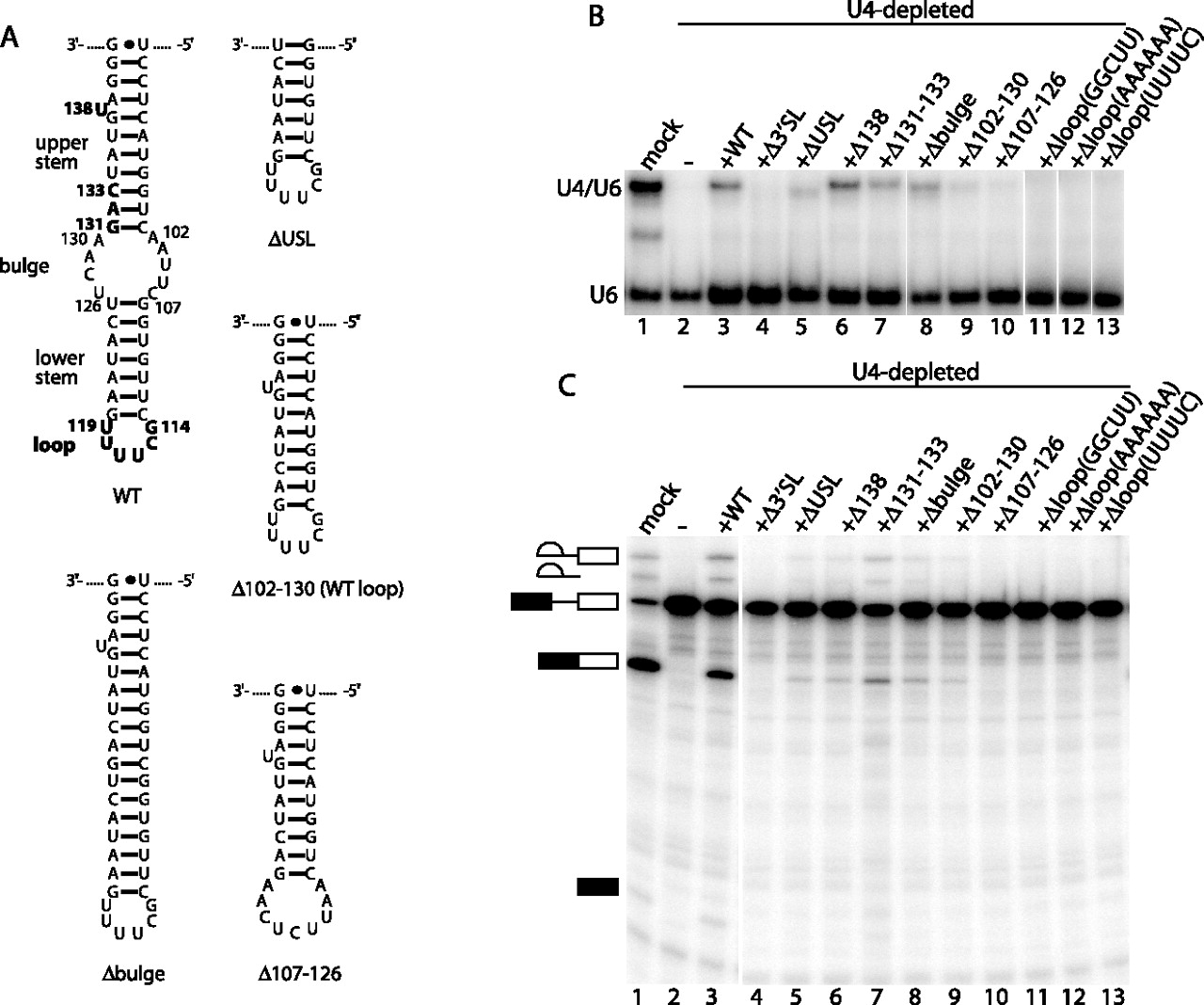
U4 3′ stem–loop mutations that form comparable levels of U4/U6 to the wild type (WT) are nevertheless defective in splicing reconstitution. (A) Secondary structures of constructs used in this experiment: WT U4 3′ stem–loop, deletion of the 11-nt bulge (Δbulge), the upper stem and bulge (ΔUSL), the bulge and lower stem (Δ102–130 [WT loop]), or the lower stem and loop (Δ107–126). Locations of deleted (138; 131–133) or mutated (loop mutations) nucleotides are shown in bold on the WT stem–loop. (B) Deletions or mutations at many positions in U4's 3′ stem–loop affect U4/U6 formation. Non-denaturing gel showing the base-pairing status of U6 in mock-depleted (lane 1) or U4-depleted (lanes 2–13) extract reconstituted using WT or mutant IVT U4. The positions of free U6 and the U4/U6 di-snRNA are indicated to the left of the gel. (C) Deletions and mutations in U4's 3′ stem–loop reduce splicing reconstitution. Denaturing gel showing splicing activity in mock-depleted (lane 1) or U4-depleted (lanes 2–13) extract reconstituted using WT or mutant IVT U4 as in B. Splicing substrate, intermediates, and products are indicated to the left of the gel, as in Figure 1.




