


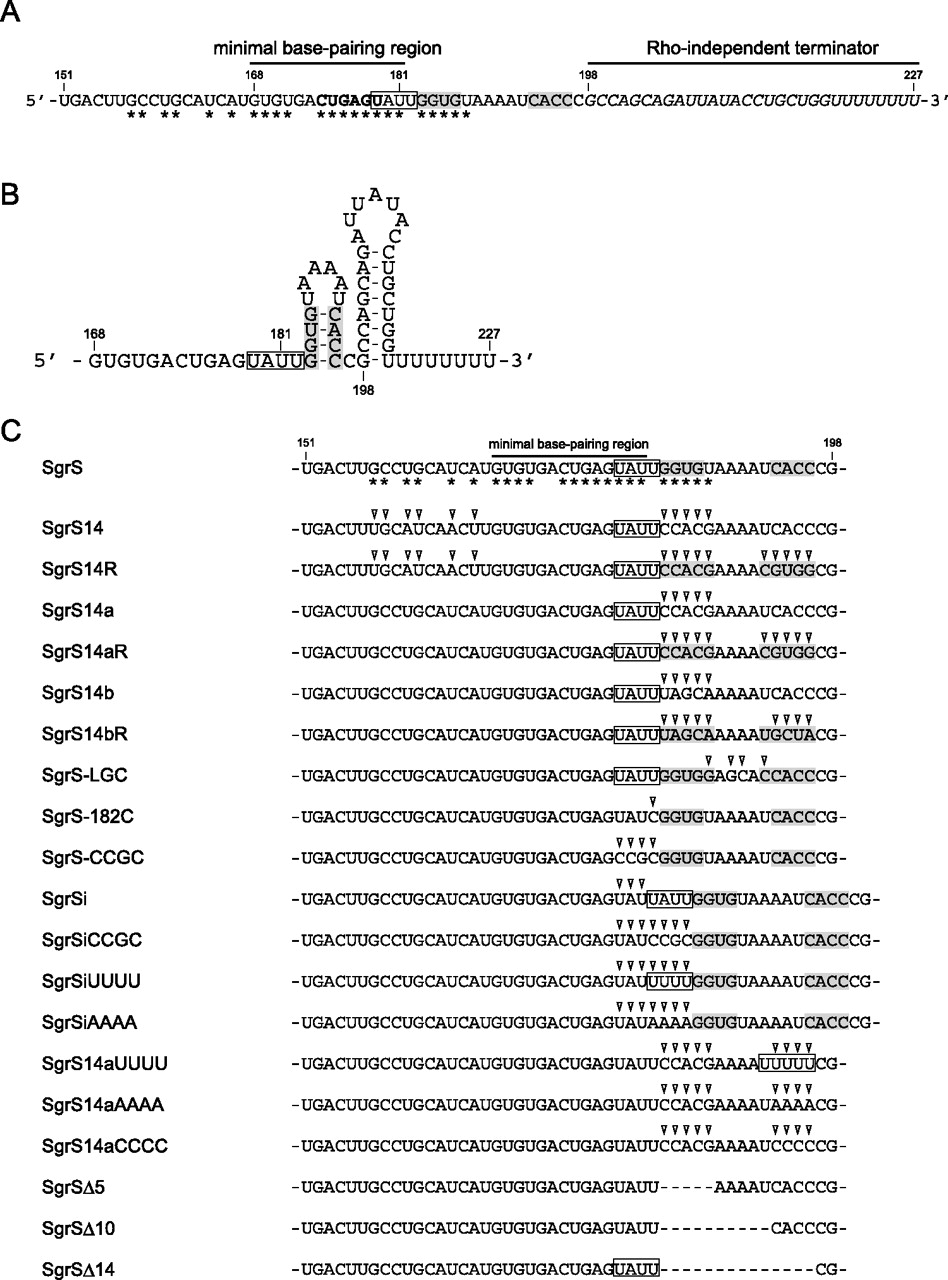
(A) The nucleotide sequence of the 3′ region of SgrS. The 3′ portion of SgrS consists of the minimal base-pairing region (168–181) (Maki et al. 2010), a terminator hairpin including a poly(U) stretch (198–227), and a spacer (182–197). (*) Nucleotides complementary to the translation initiation region of ptsG mRNA (Vanderpool and Gottesman 2004). The bold letters represent the crucial nucleotides for SgrS action (Kawamoto et al. 2006). The inverted repeat sequences in the spacer region are shadowed. The UAUU sequence before the potential hairpin structure is boxed. The Rho-independent terminators are italicized. (B) The predicted secondary structure of the 3′ portion of SgrS. (C) The nucleotide sequences of the 3′ portion of SgrS variants. (Arrowheads) Nucleotides changed from the wild-type SgrS sequence. The inverted repeat sequences in the spacer region are shadowed. The U-rich sequences before internal or terminator hairpins are boxed.




