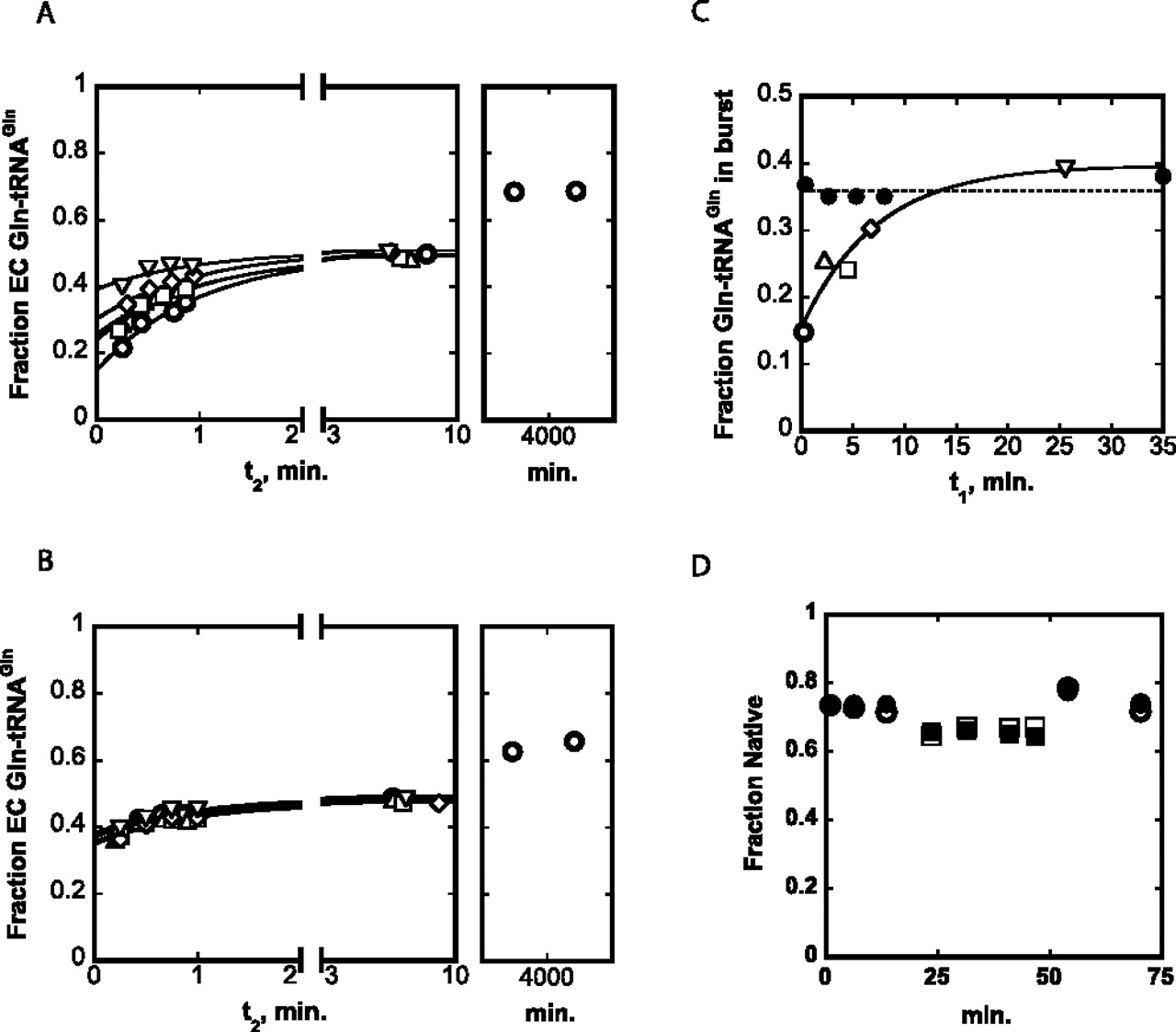
Role of modifications in folding. (A) Reaction progress curves at 8°C using unmodified E. coli tRNA1Gln(UUG) substrate taken from a folding reaction performed at 0°C. Reactions were initiated by addition of GlnRS to a final concentration of 5 μM, after folding incubation times (t1) of 0.25 min (circles), 2.25 min (triangles), 4.5 min (squares), 6.75 min (diamonds), and 25.5 min (inverted triangles). (B) Reaction progress curves at 8°C using fully modified E. coli tRNA1Gln(UUG) substrate taken from a folding reaction performed at 0°C. Reactions were initiated by addition of 500 nM GlnRS after folding incubation times (t1) of 0.4 min (circles), 2.7 min (triangles), 5.3 min (squares), 8.1 min (diamonds), and 35 min (inverted triangles). The right panels in A and B represent maximal aminoacylation levels of tRNA transcript and in vivo tRNA that were folded for several days at 8°C. (C) Replots of aminoacylation burst amplitude with folding time t1. Reactions for in vivo tRNA1Gln(UUG) are shown in filled circles (data taken from panel B), and reactions of the unmodified transcript are shown as open symbols (data taken from panel A). (D) Maximum aminoacylation levels of prefolded (heat-denatured and slow cooled) E. coli tRNAGln transcript (open symbols) and in vivo tRNAGln (closed symbols). Both incubation of pre-folded tRNA and aminoacylation are performed at 21°C (circles) and 8°C (squares).