


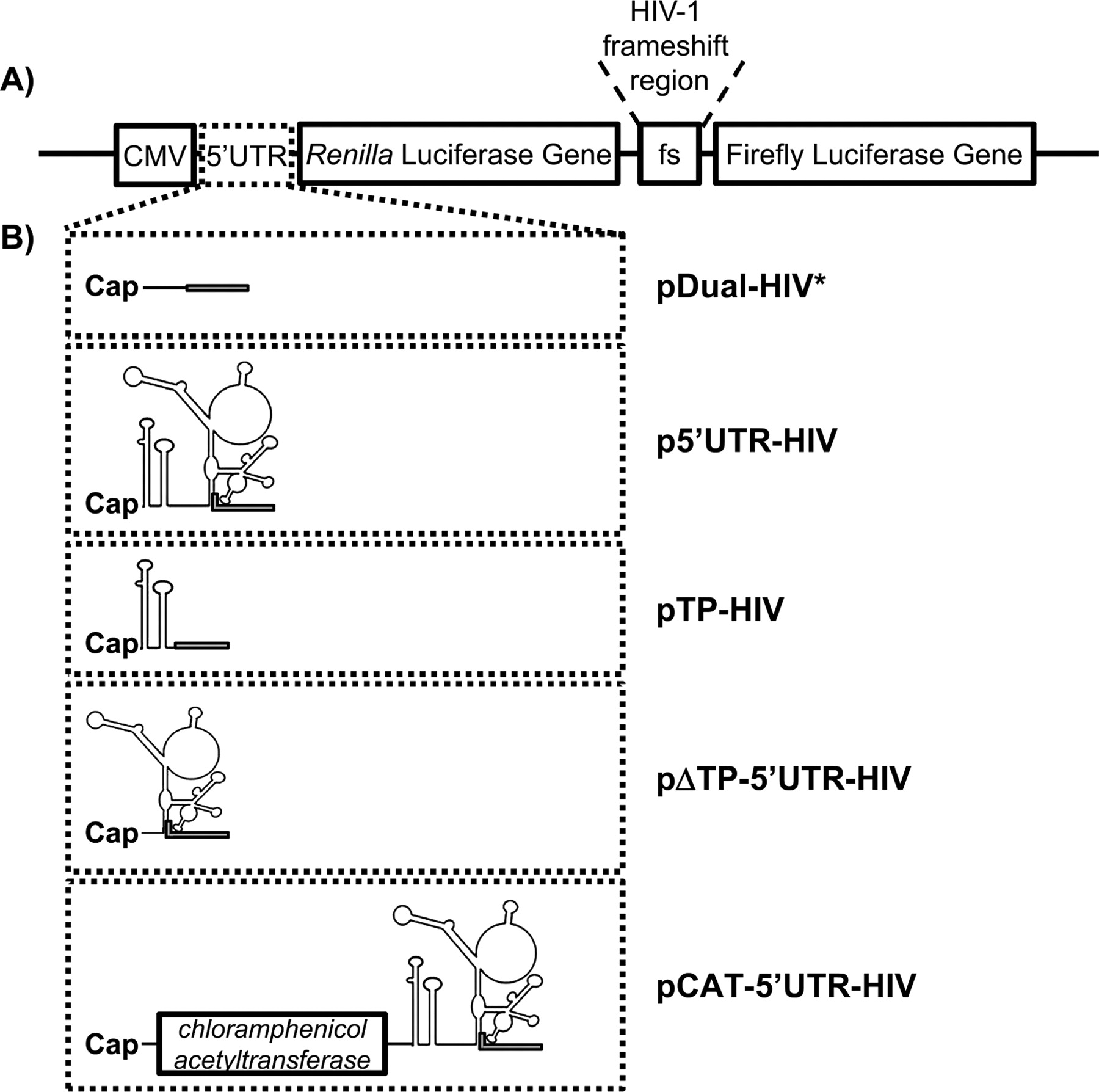
Scheme of the vectors used to assess HIV-1 frameshift efficiency. (A) Representation of a dual-luciferase reporter. All of the reporters used in this study are derivatives of this dual-luciferase reporter, which differ in their 5′ UTR. They contain the Renilla (Rluc) and the firefly luciferase (Fluc) coding sequences, under control of a CMV promoter, and separated by the HIV-1 frameshift region (nucleotides 1608–1685 in pLAI). Rluc is synthesized by all of the ribosomes translating the mRNA, whereas Fluc is synthesized, as a fusion to Rluc, only by ribosomes that make a −1 frameshift in the frameshift region. (B) Details on the 5′ UTR of the different reporter mRNAs used in this study. Plasmid pDual-HIV* has a short and unstructured 5′ UTR. The plasmid p5′UTR-HIV contains the complete 5′ UTR of HIV-1 full-length mRNA (nucleotides 1–335 in pLAI). The plasmid pTP-HIV contains the beginning of the 5′ UTR of HIV-1 full-length mRNA encompassing the TAR and poly(A) structures (nucleotides 1–106 in pLAI). The plasmid pΔTP-5′UTR-HIV contains a part of the HIV-1 full-length mRNA 5′ UTR (nucleotides 95–335 in pLAI), which encompasses HIV-1 IRES but not TAR and poly(A). Finally, the plasmid pCAT-5′UTR-HIV was designed such that translation of the CAT sequence results from a cap-dependent initiation, whereas the production of the luciferases, preceded by the 5′ UTR of HIV-1 full-length mRNA, results from an IRES-dependent initiation. In pDual-HIV* and pTP-HIV, only the cap-dependent initiation is available. In pΔTP-5′UTR-HIV and p5′UTR-HIV, both cap- and IRES-dependent initiations could be possible. In all of the plasmids, the AUG initiator codon for Rluc is followed by the first 30 nt from the gag coding region. Also, an oligonucleotide coding for a peptide linker was inserted between the nucleotide from gag and the beginning of the Rluc coding sequence. The AUG codon and the 30 nt from gag plus the linker are represented by an open box.




