


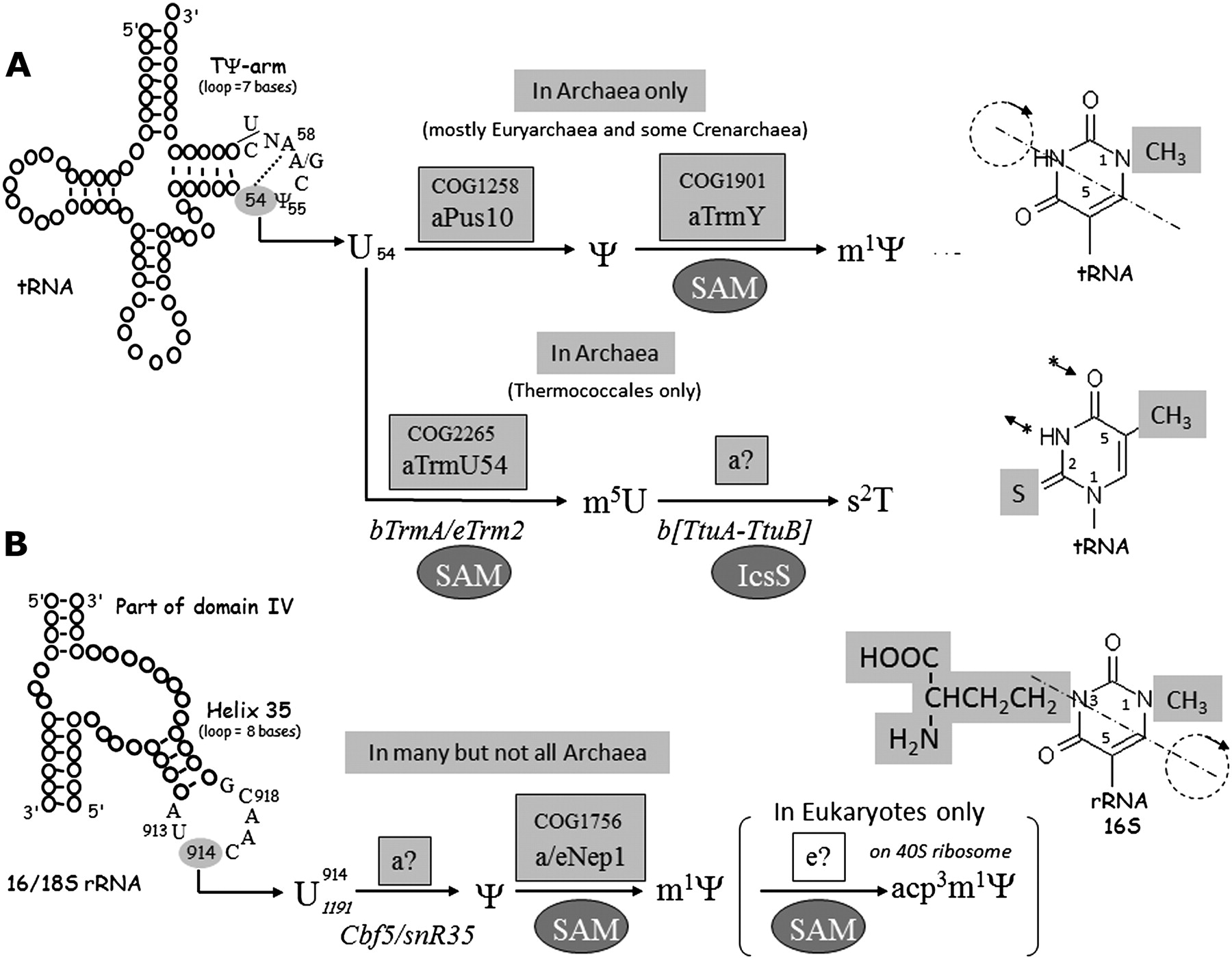
Enzymatic post-transcriptional modifications of selected uridines in RNA. (A) Schematic consensus of tRNA secondary structures indicating the U54 target within the highly conserved 7-nt TΨ-loop. The dashed line indicates a reverse Hoogsteen base pair within the loop. In the majority of Archaea, U54 is first isomerized into Ψ54 by a tRNA pseudouridine synthase, aPus10 (symbol “a” preceding the acronym of the enzyme denotes “archaeal,” “b” means “bacterial,” and “e” means “eukaryal”). In certain Archaea, Ψ54 can be further methylated into m1Ψ54 by a SPOUT-type, SAM-dependent methyltransferase designated TrmY (this work). In Thermococcales, Bacteria, and Eukarya, U54 is methylated into m5U54 (riboT) by a distinct SAM-dependent tRNA-U54 methyltransferase aTrmU54, bTrmA, and eTrm2p, respectively. In thermophilic organisms, m5U54 can be further thiolated into s2m5U (s2T) by the heteromeric enzyme TtuA/TtuB. (B) Schematic consensus of a portion of 16S rRNA as part of domain IV, encompassing the highly conserved 8-nt helix 35 Ψ-loop. U914 in 16S rRNA of M. jannaschii, corresponding to U1191 in 18S rRNA of S. cerevisiae, is first isomerized into Ψ by an archaeal enzyme (or enzymatic system) that remains to be identified. In S. cerevisiae this reaction is mediated by the snoRNP complex consisting of the pseudouridine synthase eCbf5 and snR35 guide RNA. The methylation of N1-atom of the uracil ring is further catalyzed by a SPOUT-type and SAM-dependent methyltransferase, Nep1 (also referred as Emg1). Only in some Eukarya (such as yeast, Drosophila, HeLa cells), is the m1Ψ further hypermodified into a acp3m1Ψ derivative. On the right part of the figure are the different uridine derivatives. The dashed lines through the structure of m1Ψ and acp3m1Ψ show the axis of base rotation during the isomerization process. The asterisks with small arrows indicate the atoms normally engaged in the reverse Hoogsteen base pair with A58.




