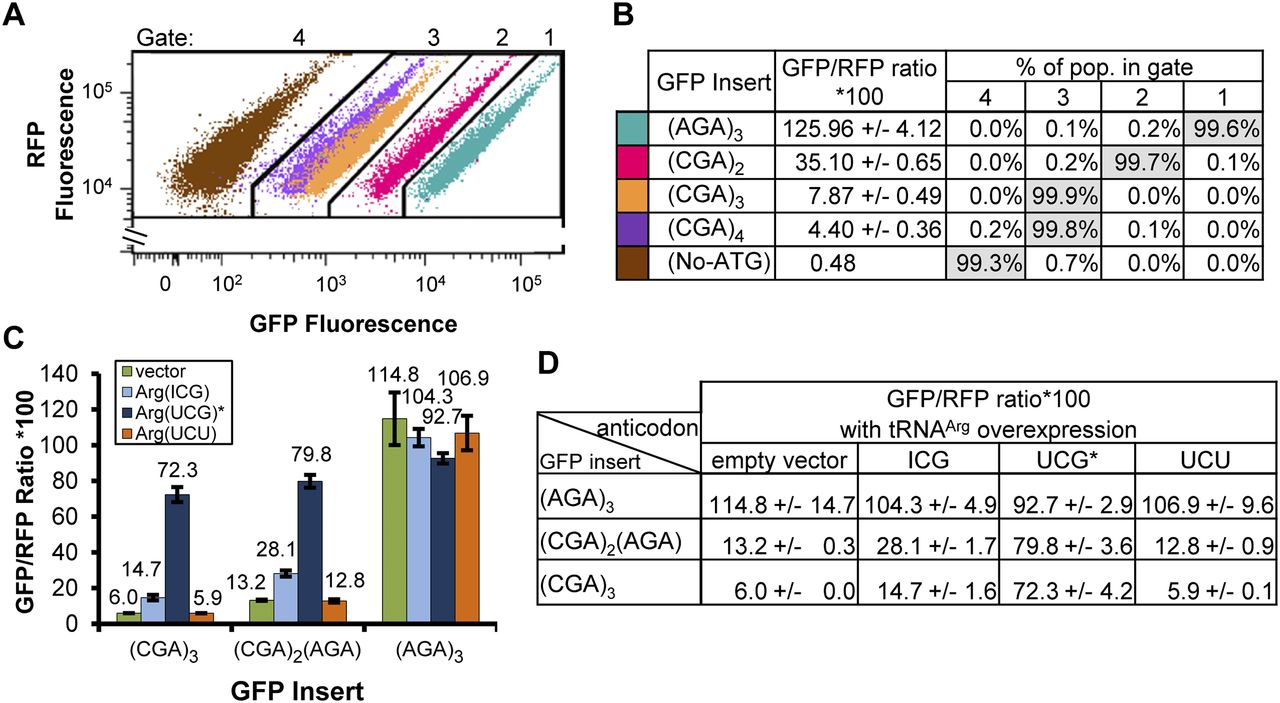
Translation regulation by arg CGA codon pairs is recapitulated with RNA-ID. (A,B) Insertion of increasing numbers of inhibitory CGA codons into the RNA-ID reporter results in progressively reduced GFP/RFP fluorescence. (A) Scatter plot of GFP fluorescence versus RFP fluorescence of yeast cells with constructs bearing the indicated sequences inserted in GFP. ((AGA)3-GFP, teal; (CGA)2-GFP, red; (CGA)3-GFP, orange; (CGA)4-GFP, purple; no ATG –GFP, brown). (B) Comparison of the median GFP/RFP value and the percentage of cells in each gate for each construct. The values reported (and the standard deviation) are the average of the median value obtained for each of four independent transformants. (C,D) Inhibition of translation by CGA codons is substantially suppressed by coexpression of a mutant tRNAArg(UCG)* that base pairs with CGA. (C) A bar graph of the GFP/RFP median of cells bearing integrated GFP constructs, and 2μ plasmids that express no tRNA (vector), tRNAArg(ICG), the mutant tRNAArg(UCG)*, or tRNAArg(UCU). (D) Quantification of expression of data in C. Each value is the average of the median values obtained for four independent transformants with each plasmid. The tRNAArg species are indicated by their anticodons in the legend and table.