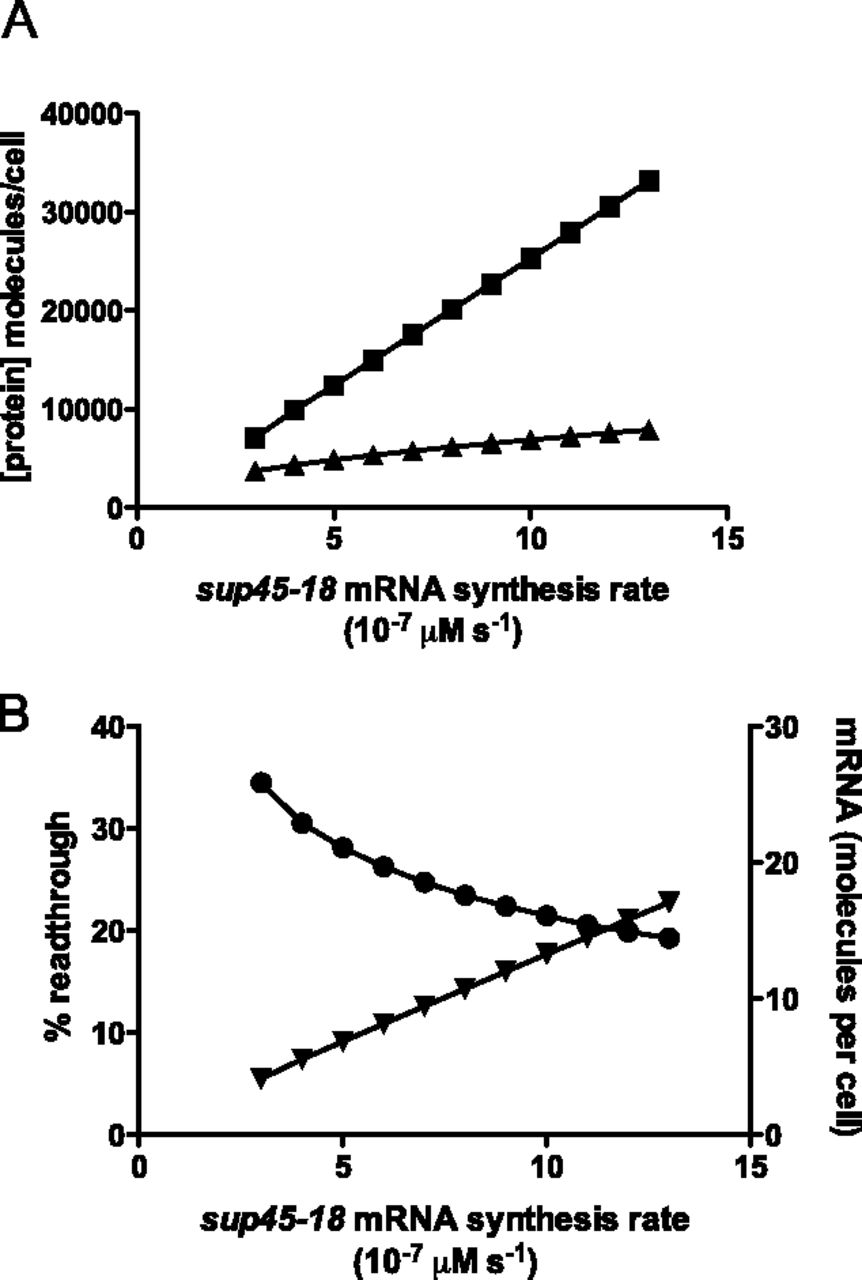
Modeling the consequences of artificially overexpressing a sup45UAA allele at the transcriptional level; feedback restricts, but does not eliminate, additional eRF1 expression. (A) The increased transcription rate of sup45-18 mRNA that was experimentally engineered using the tet-off regulatable promoter system (Fig. 4) was replicated using Model 3, revealing that increased transcription of the sup45UAA allele causes enhanced production of (■) truncated eRF1 (eRF1-tr), but proportionately less eRF1 production (▴) as the mRNA synthesis rate is raised. (B) Increased production of sup45-18 mRNA (▾) results from increased transcription rates, and levels of stop codon readthrough (●) decrease as sup45-18 mRNA translation produces more truncated eRF1 (eRF1-tr), but disproportionately less full-length eRF1.