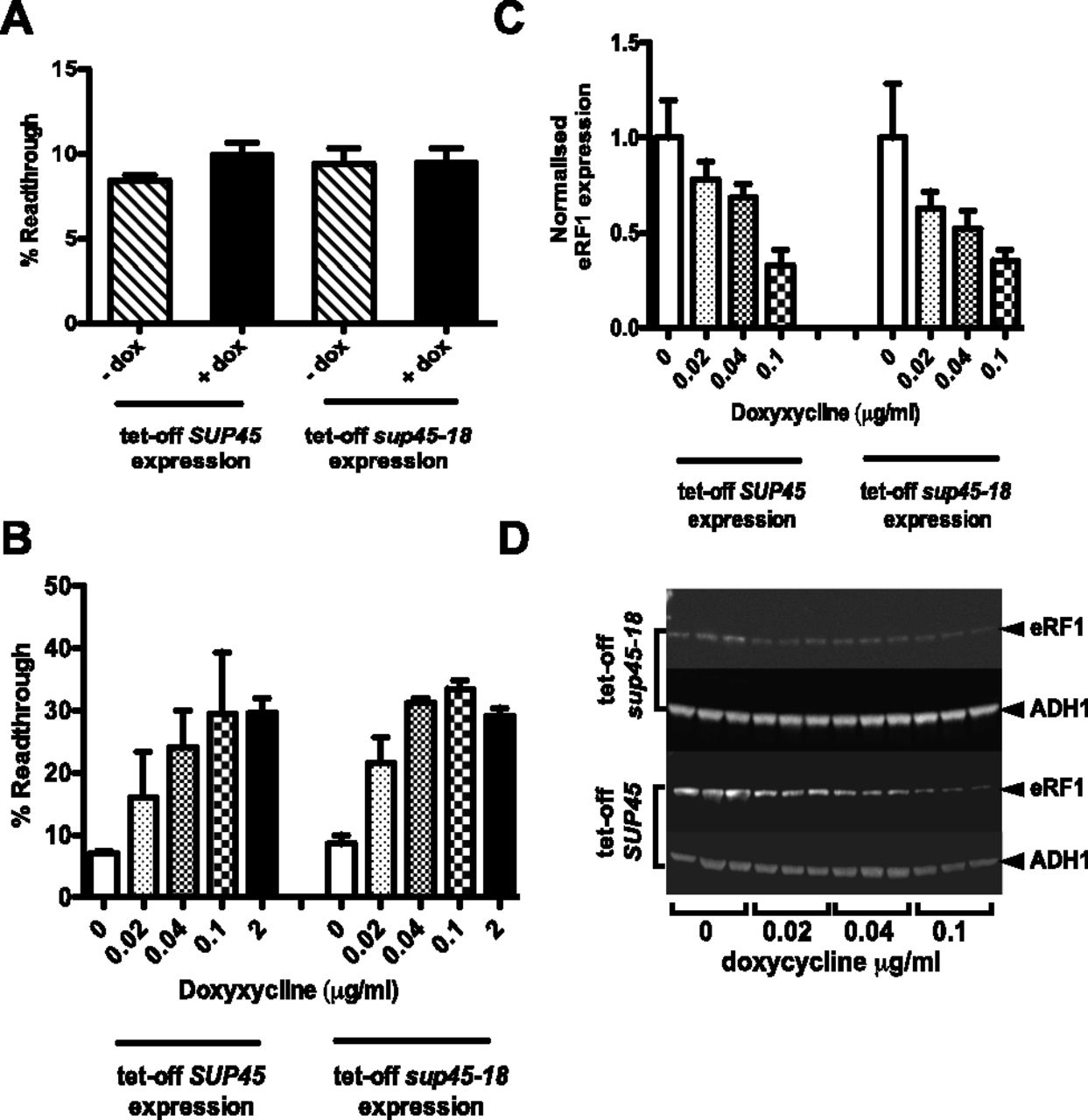
Stop codon readthrough in the sup45 nonsense alleles responds to perturbation by increased levels of SUP45 mRNA engineered using a doxycycline regulatable promoter. (A) Using the dicistronic reporter gene assay carrying a UAA stop codon in the sup45-18 context (pBET-18), UAA stop codon readthrough was assessed in a yeast strain wild-type for eRF1, but carrying the SUQ5 suppressor tRNA, and transformed with either plasmid pMER or pMER-18. These express, respectively, the SUP45 or sup45-18 alleles under control of a tet-off promoter that allows the system to be perturbed by inducing the expression of extra copies of the respective mRNAs, and responses measured. Transformants were grown in the absence (striped bars) or presence (filled bars) of 2 μg/mL doxycyline. Bars represent the mean of three independent transformants ±1 standard deviation. (B) pMER (allowing doxycycline-regulated expression of the SUP45 allele) or pMER-18 (allowing doxycycline-regulated expression of the sup45-18 allele) was transformed into a sup45-18, SUQ5 yeast strain. Readthrough of a UAA stop codon in the sup45-18 premature stop codon context was assessed using readthrough assay vector pBET-18. Cultures were grown in a range of doxycycline concentrations to regulate Sup45p expression, and readthrough levels were quantified. Levels of full-length eRF1 were also quantified (C) in the same mutant using the tet-off regulated expression of eRF1 described above, using quantitation of Western blot analysis (D). Blots were probed with both anti-eRF1 antibody and protein loadings normalized using anti-alcohol dehydrogenase 1 (Adh1p) antibody as a constitutively expressed control protein.