


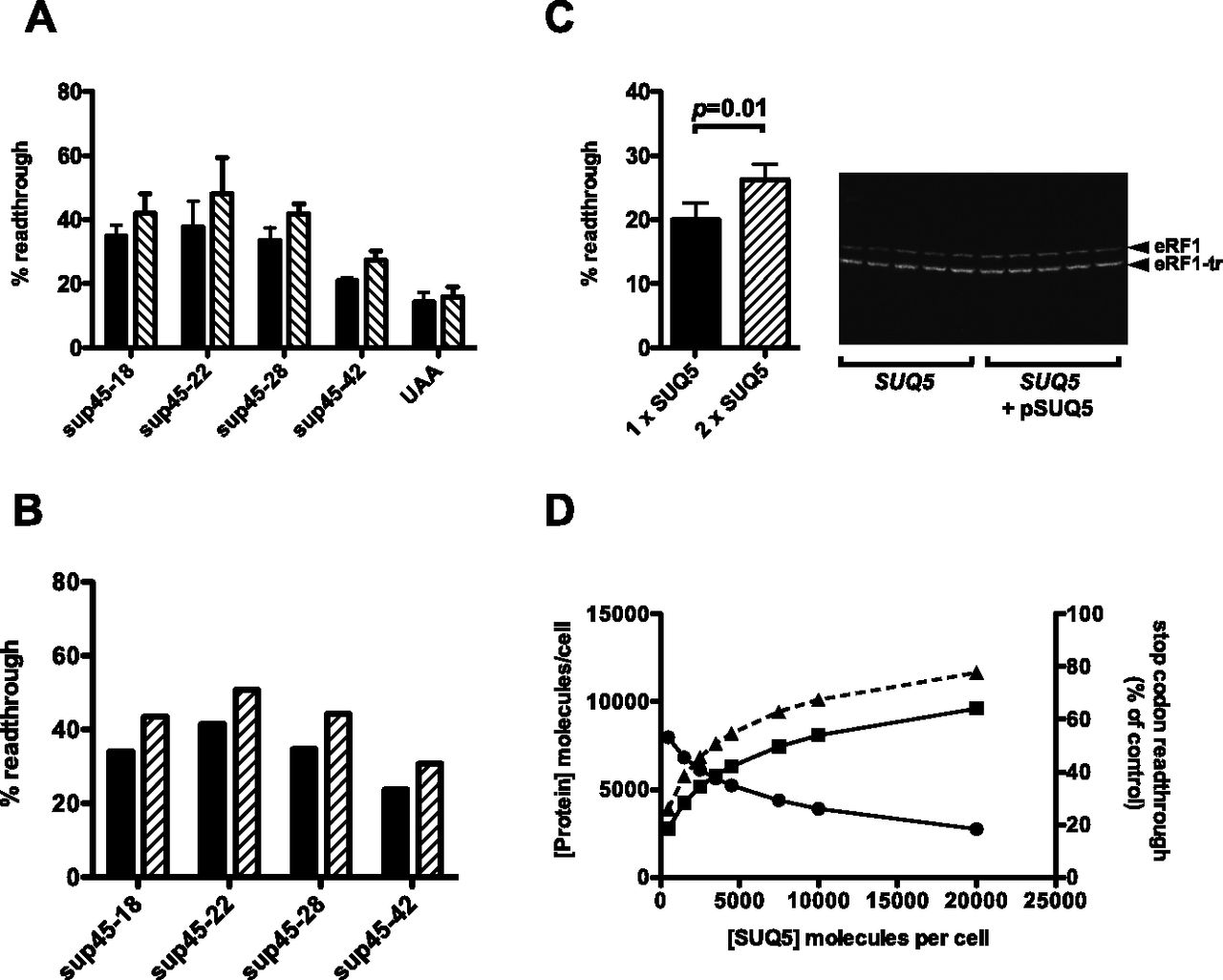
Stop codon readthrough in the sup45 nonsense alleles responds to perturbation by increased levels of suppressor tRNA. (A) Using the galactosidase-luciferase dicistronic reporter assay, stop codon readthrough (UAA codon) was assessed in four eRF1 nonsense allele yeast strains with a sup45 SUQ5 genotype (filled bars), as well as in sup45 SUQ5 [pSUQ5] transformants (striped bars), in which the level of SUQ5 tRNA had been supplemented by transformation with a plasmid-borne copy of the SUQ5 gene encoding an ochre suppressor seryl-tRNA. Bars represent the mean of three independent transformants ±1 standard deviation. (B) A mathematical model of the eRF1 translational negative feedback loop was used to simulate readthrough levels in the sup45 SUQ5 mutant backgrounds (filled bars), as well as in the sup45 SUQ5 [pSUQ5] transformants (striped bars), in which SUQ5 tRNA gene copy number was doubled. (C) Using Western blot analysis with polyclonal anti-eRF1 antibody, the levels of eRF1 premature stop codon readthrough were directly quantified in the sup45-42 SUQ5 mutant with, and without, an extra plasmid-borne SUQ5 gene copy. Expression of full-length and truncated eRF1 was quantified in five independent transformants of each type using a CCD camera, and readthrough levels calculated and significance tested using a t-test. (D) Model prediction of the response of the sup45 feedback loop to increases in SUQ5 suppressor tRNA level, showing predicted levels of eRF1 (■), truncated eRF1 (●), and readthrough (▴, dashed line).




