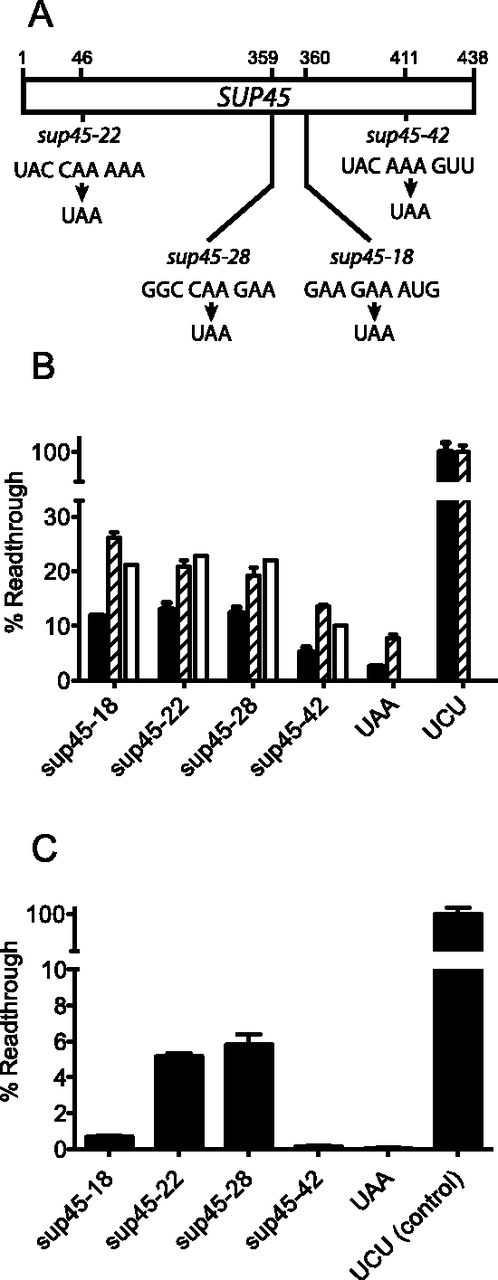
The sup45 allele premature stop codons are in non-optimal nucleotide contexts. (A) Positions of the SUP45 allele premature stop codons and their immediate nucleotide contexts. (B) The readthrough of UAA stop codons in sup45 nonsense allele contexts was assessed using reporter assay readthrough vectors (pBET-18, -22, -28, -42, and -UAA) (Materials and Methods). Each comprised the relevant sup45 premature stop codon and its surrounding context, cloned between lacZ and luc reporters. Readthrough of these stop codons was compared with that of a UAA stop codon in an optimal context, using the dicistronic plasmid reporter pBET-UAA. Readthrough assays were performed in yeast strains (BSC483/1a; SUP45+ SUQ5) carrying either a genomic SUQ5 nonsense suppressor tRNA allele (filled bars), or with a genomic SUQ5 allele and additionally transformed with a plasmid carrying an extra copy of the SUQ5 allele (pSUQ5; striped bars). Bars represent the mean of three independent transformants, ±1 standard deviation. To validate the mathematical model of eRF1-SUQ5 tRNA competition, Model 2 was used to simulate readthrough levels of a generic UAA stop codon in the sup45 SUQ5 [pSUQ5] transformants (open bars). (C) The UAA readthrough frequency of the premature stop codons in alleles sup45-18, -22, 28, and -42 was assessed in a yeast strain BY4741 (wild-type suq5+ with respect to tRNA suppression), transformed with the same range of stop codon readthrough assay vectors (pBET-18, -22, -28, 42). All bars represent the mean of three independent transformants, ±1 standard deviation.