


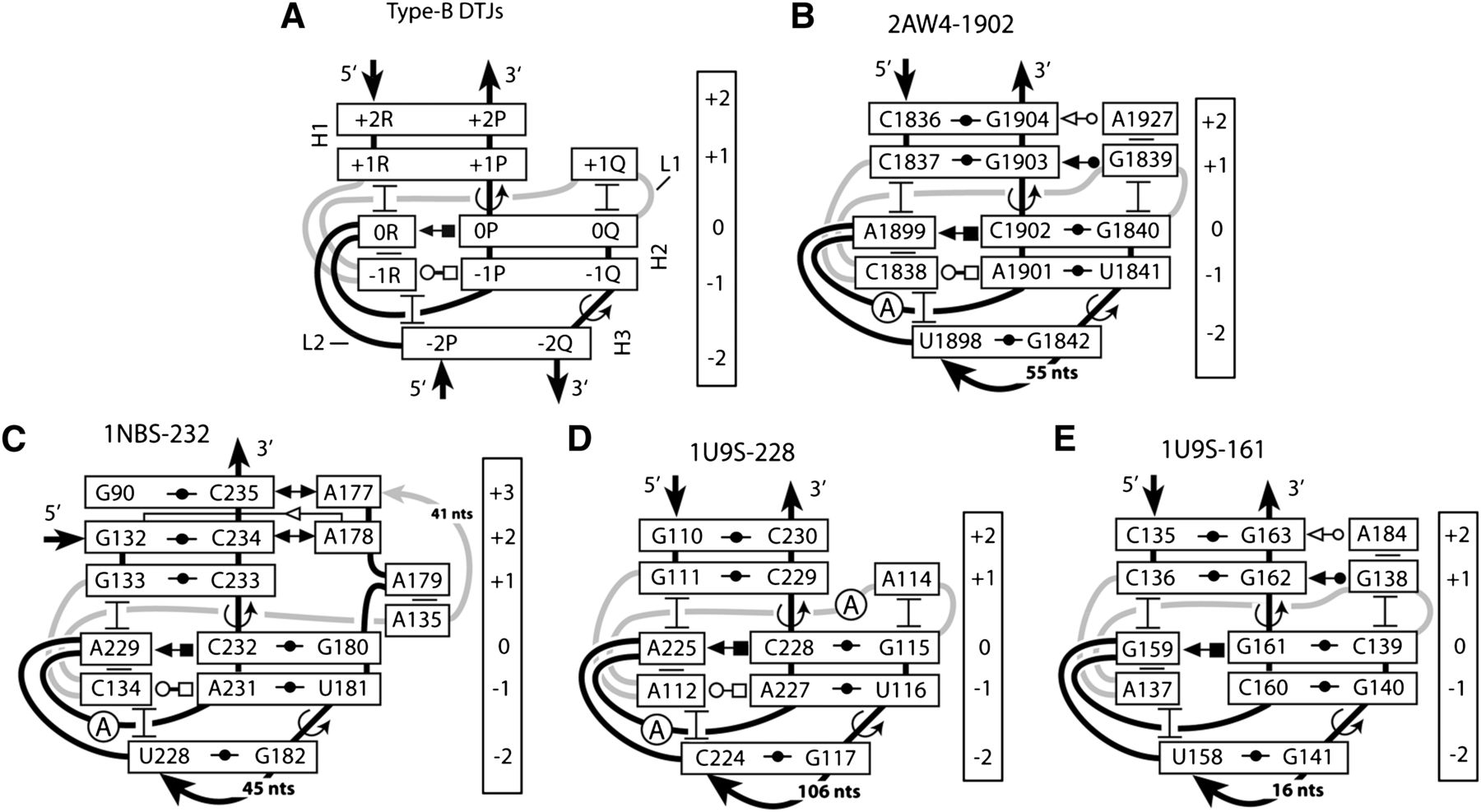
Structure of B-DTJ motifs. (A) The general scheme of the B-DTJ motif. The TJ1 and TJ2 occur between base pairs [0P;0Q] and [+1R;+1P] and between base pairs [−1Q;−1P] and [−2Q;−2P], respectively. (B–E) Motifs 1U9S-161 and 1U9S-228 exist in the T. thermophilus RNase P (Krasilnikov et al. 2004), motif 1NBS-232 exists in the Bacillus subtilis RNase P (Krasilnikov et al. 2003), while motif 2AW4-1902 exists in the E. coli 23S rRNA (Schuwirth et al. 2005). In the presented structures, base pairs [+2P;+2R], [+1P;+1R], [0P;0Q], and [−1P;−1Q] are always WC, while base pair [−2P;−2Q] is either UG or CG. Nucleotides 0R and 0P form a cis-SE-HG base pair. Nucleotide +1Q, if present, forms either a cis-HG-SE or cis-WC-SE base pair with nucleotide +1P. Nucleotide −1R in structures B through D forms a trans-HG-WC base pair with −1P.




