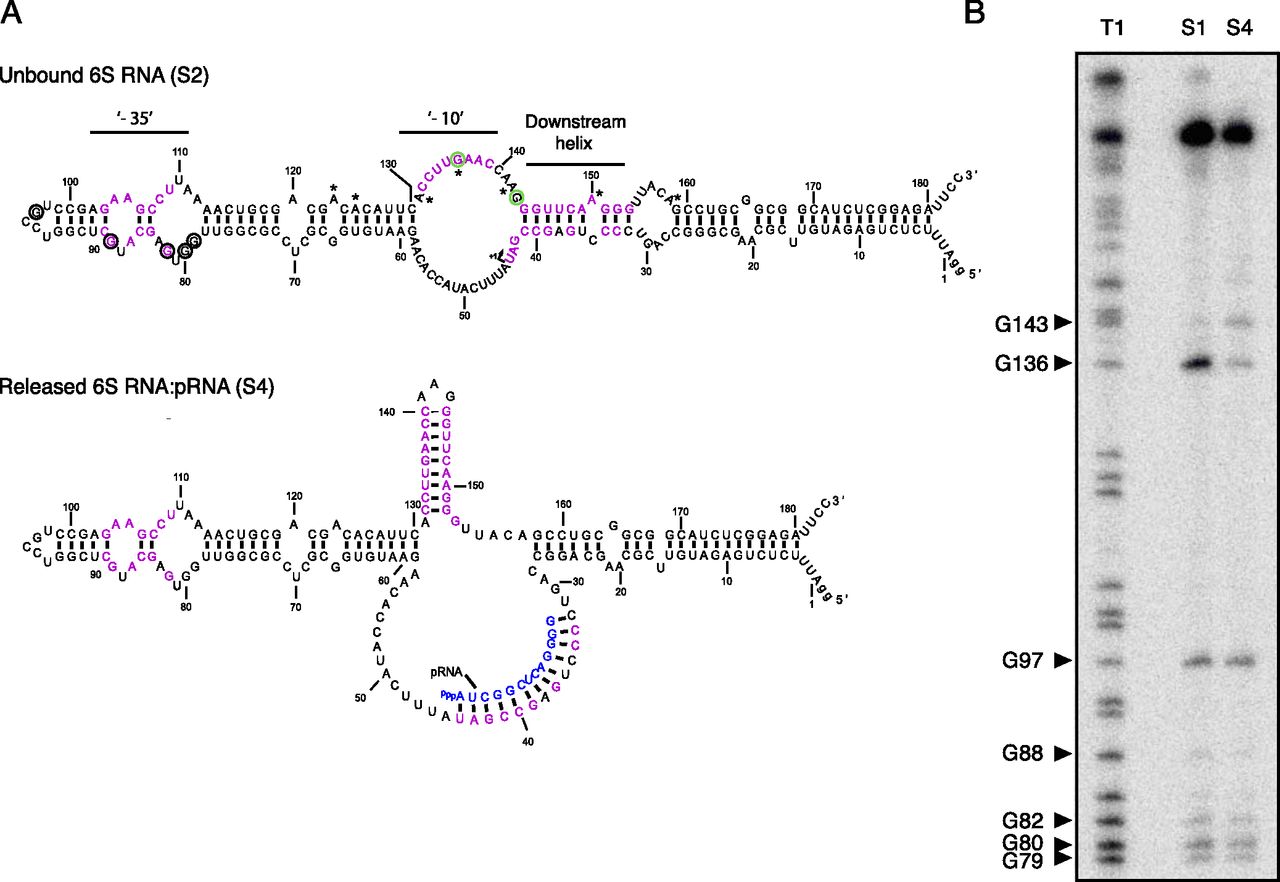
Presence of hairpin in the released 6S:pRNA complex. (A) Highly conserved residues in the unbound 6S RNA (S1 state) from γ-proteobacteria are shown in purple. pRNA is shown in blue. The hairpin forms in the released 6S RNA:pRNA complex (S4 state) between the phylogenetically conserved “−10” region and the top strand of the downstream helix. Green circles indicate G residues that change their protection pattern upon release, while black circles indicate single-stranded G residues that are unaffected by the release process. Residues previously shown to form UV crosslinks with holoenzyme in the bound Eσ70 (S2 state) are marked with asterisks (Gildehaus et al. 2007). (B) Native T1 RNase digestion of 5′ 32P end-labeled 6S RNA before binding (S1) and after pRNA induced release (S4). Analyzed using 10% denaturing PAGE. T1 indicates denaturing T1 RNase digest of the 6S RNA unbound construct.