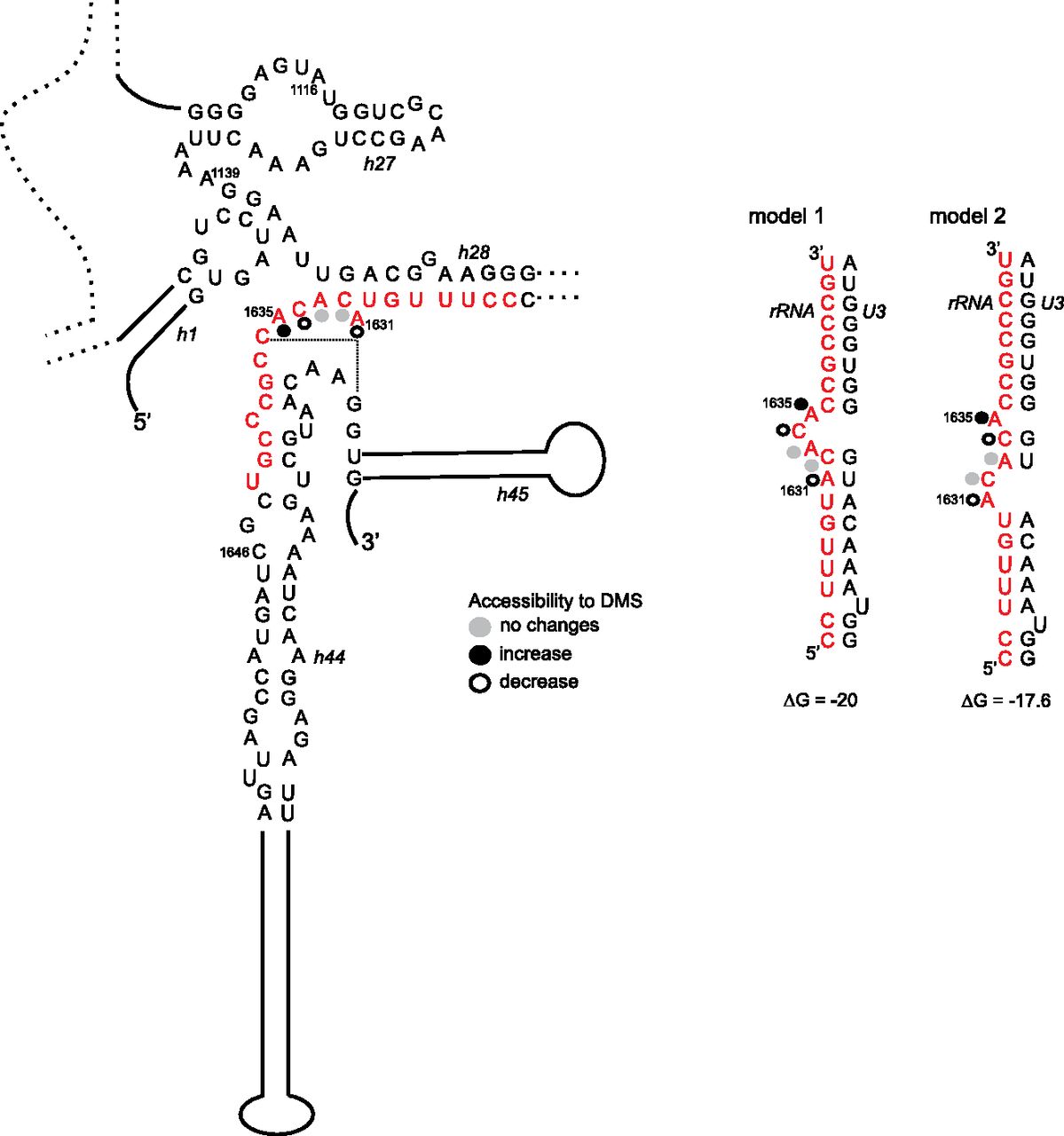
Potential U3 snoRNA–pre-rRNA interactions. Secondary structure models of U3–pre-rRNA chimeras. Changes in the intensity of DMS modifications in newly synthesized RNA after 4 min of labeling compared with total RNA displayed on the secondary structure model of the analyzed part of rRNA. Based on the CLASH data, part of helix 3 and helix 5 of U3 snoRNA can interact with the region close to the 3′ side of the pseudoknot of 18S rRNA (Kudla et al. 2011). Alternative models for the structure of the U3 snoRNA–rRNA chimera, as predicted by the RNAStructure program. The predicted stable stem formed between the 3′ region of the rRNA and U3 snoRNA is supported by the lack of modification at C1636 and C1637. Higher reactivity of A1635 fits with both chimera structure models. Based on both the structure predictions and DMS modification patterns, the central region of the chimera is less stable with the potential for structural rearrangements.