


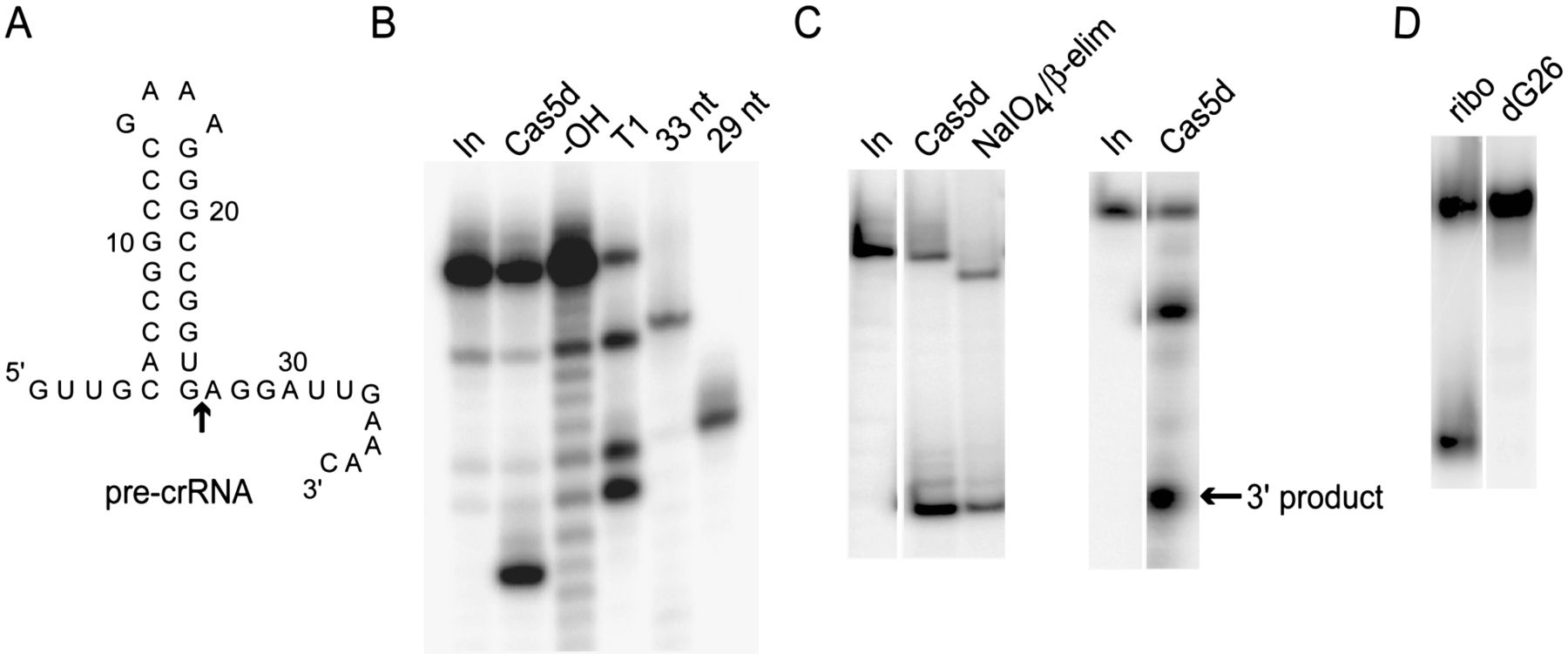
Characterization of cleavage products and mechanism of RNA cleavage by Cas5d. (A) Secondary structure of T. thermophilus Dvulg repeat RNA. Position of RNA cleavage is indicated by arrow. (B) Mapping of cleavage location by denaturing PAGE showing comparison to RNase T1 and base hydrolysis ladders. Also shown are 29- and 33-nt RNA size markers corresponding to 3′ truncations of the pre-crRNA. (C, left) Periodate/base elimination of pre-crRNA treated with Cas5d affects the mobility of the full-length pre-crRNA, but not that of the 5′ product, indicating that the latter has a modified 2′/3′ terminus. (C, right) The smaller of two RNAs produced upon Cas5d cleavage of pre-crRNA is labeled by 32P upon treatment with T4 polynucleotide kinase, indicating the presence of a free 5′ hydroxyl on the 3′ product. (D) A modified pre-crRNA substrate containing a dG residue at position 26 is not cleaved by Cas5d supporting a model whereby RNA cleavage occurs by intramolecular attack of the G26 2′ hydroxyl on the scissile phosphate.




