


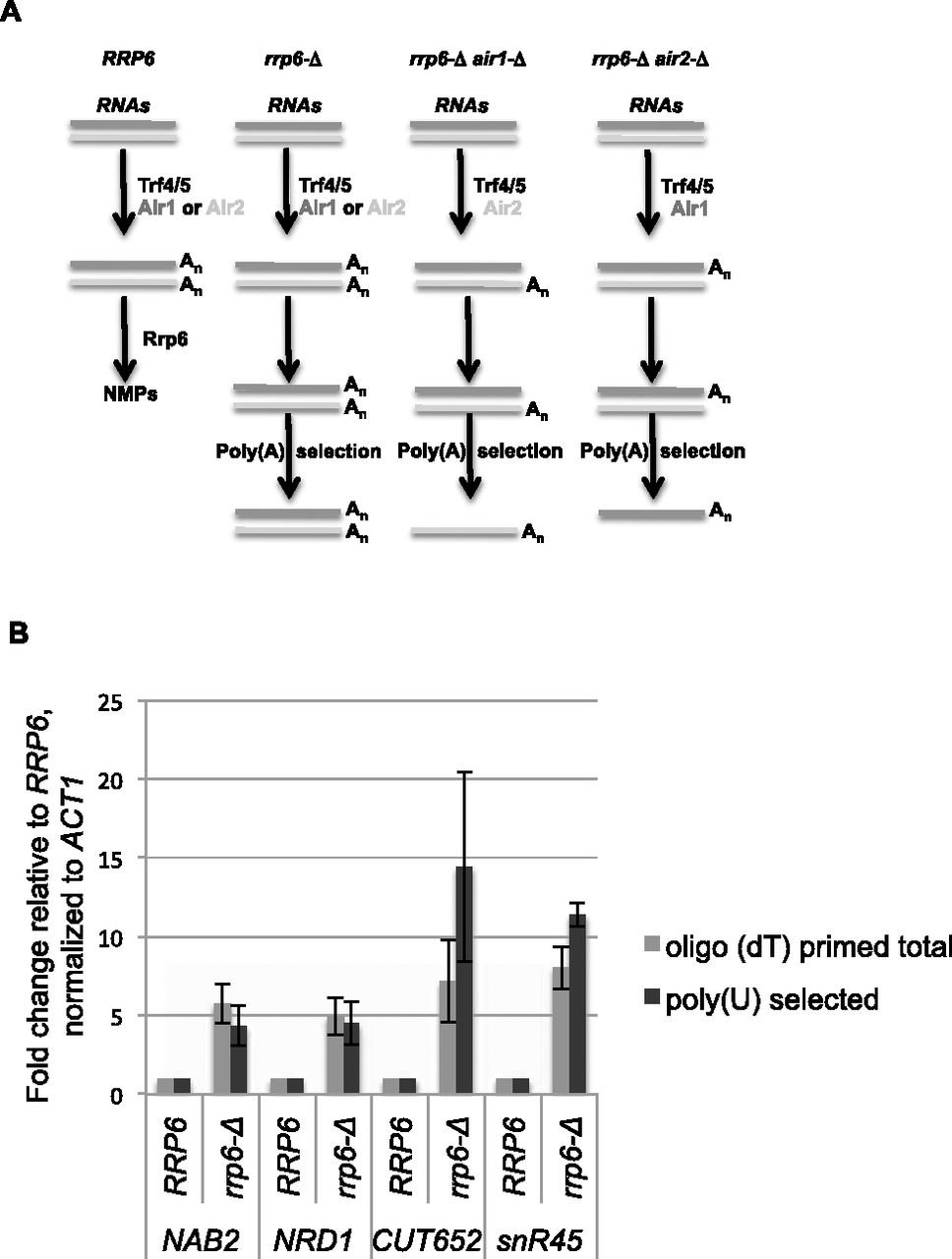
(A) Experimental approach to identify Air protein targets. Strains with the genotypes indicated at the top of the figure will contain RNAs (dark or light gray) targeted for Trf4- or Trf5-catalyzed polyadenylation by Air1 (dark gray) or Air2 (light gray), respectively. Polyadenylated forms of these RNAs will accumulate in rrp6-Δ cells (left). RNAs specifically targeted for polyadenylation by Air1 or Air2 will be lost when either gene is deleted. Differential loss of the poly(A)+ RNAs is assayed by poly(U)-Sepharose selection and RNA sequencing. (B) Quantification of the levels of specific transcripts in RNA samples before and after poly(U)-Sepharose selection. Real-time qRT-PCR analysis of NRD1, NAB2 mRNA, CUT652 RNA, and snR45 RNA before [oligo(dT)-primed total] or after [poly(U)-selected) poly(U)]-Sepharose selection. All histograms represent the fold change of the transcript compared to WT (RRP6) after normalization to ACT1 mRNA. Error bars represent standard deviations calculated from two independent reactions.




