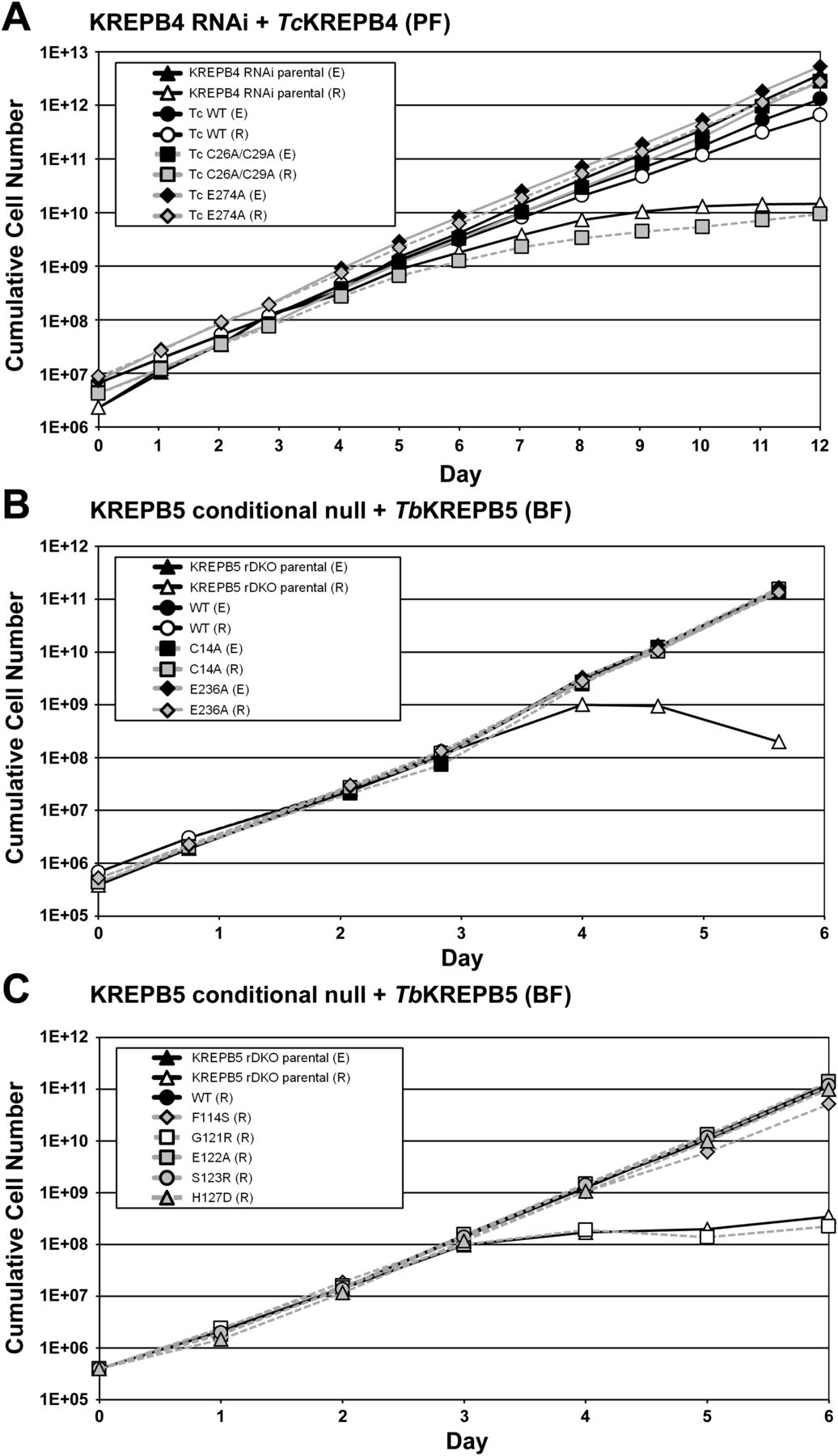
Growth analysis of exclusively expressed mutant versions of KREPB4 or KREPB5 reveals amino acids essential for function. (A) Repression (R) of KREPB4 by inducing RNAi in parental PF cell line causes a large growth defect compared to uninduced cells with endogenous KREPB4 expression (E). Exclusive expression of wild-type KREPB4 from T. cruzi (Tc WT) allows cells to grow well after repression of endogenous KREPB4 by RNAi. While exclusive expression demonstrates that the E284A mutation permits near-normal growth (Tc E284A (R)), the C51A/C54A mutation prevents KREPB4 function (Tc C51A/C54A (R)). (B) Repression (R) of KREPB5 in the parental BF conditional null cell line leads to growth defect compared with cells expressing wild-type KREPB5 (E). Exclusive expression of wild-type and mutant KREPB5 proteins permits normal growth (WT (R), C14A (R), or E236A (R)). (C) Exclusive expression of additional KREPB5 mutant proteins reveals essential amino acids. Control parental BF KREPB5 conditional null cell line demonstrates growth defect when KREPB5 is repressed (R) compared to expressed (E). While exclusive expression of some KREPB5 proteins permits normal growth (WT (R), E122A (R), S123R (R), H127D (R)) others produced slight (F114S (R)) or major (G121R (R)) growth defects. As all cell lines grew normally with tetracycline-regulated KREPB5 expressed, growth curves for cells that express mutant alleles have been omitted for clarity.