


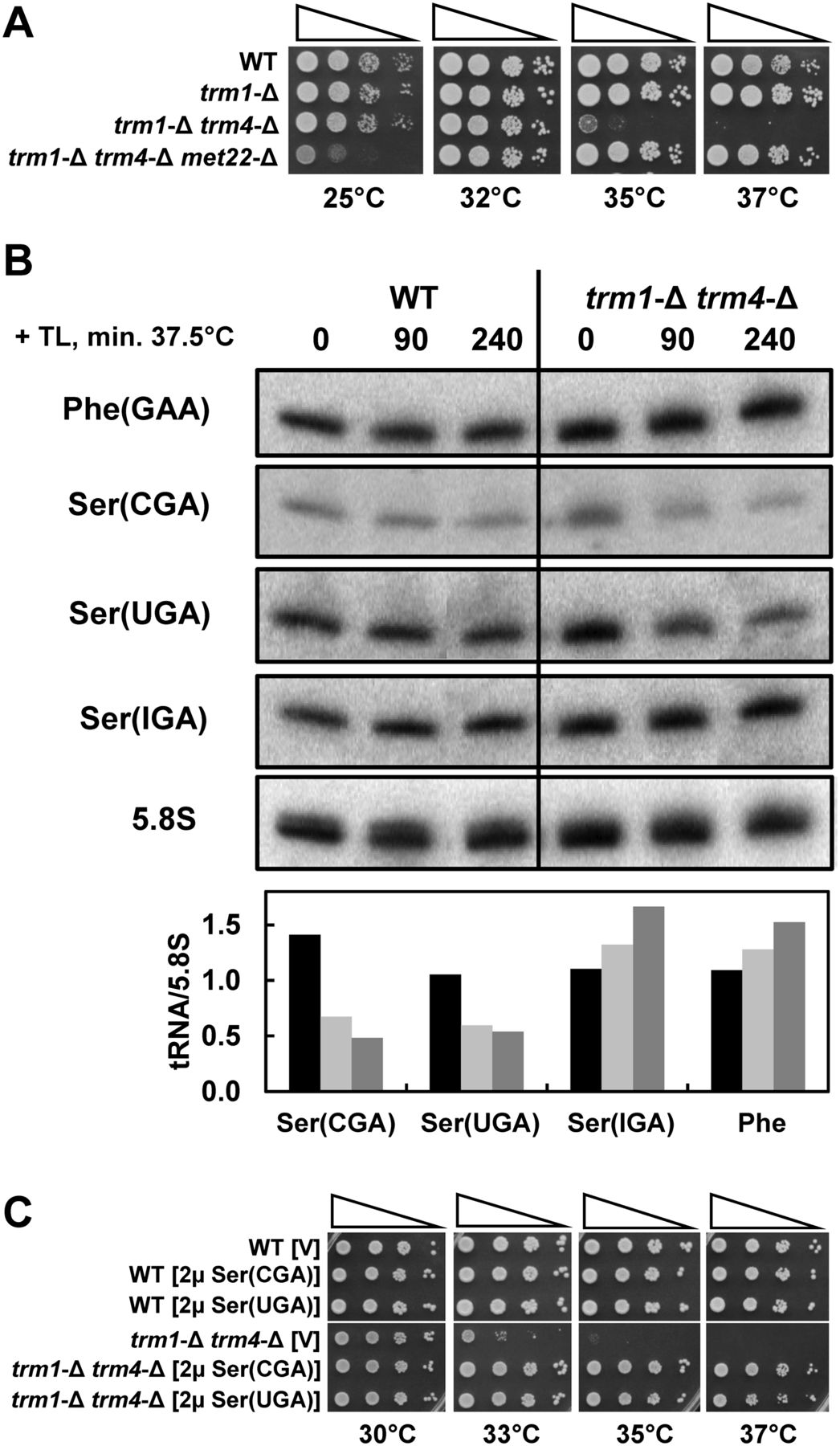
trm1-Δ trm4-Δ mutants are subject to RTD of tRNASer(CGA) and tRNASer(UGA). (A) The temperature sensitivity of trm1-Δ trm4-Δ mutants is suppressed by a met22-Δ mutation. Strains were grown, diluted, and plated on YPD plates as described in Figure 3A. (B) trm1-Δ trm4-Δ mutants have reduced levels of tRNASer(CGA) and tRNASer(UGA). Wild-type or trm1-Δ trm4-Δ strains were grown in YPD media at 28°C, treated with thiolutin (TL), and shifted to 37.5°C, and RNA from cells was analyzed by hybridization at the times indicated. Quantification of RNA levels was done as described in Figure 2B. Bars in black indicate 0 min; light gray, 90 min; and dark gray, 240 min. (C) The temperature sensitivity of trm1-Δ trm4-Δ mutants is suppressed by overproduction of tRNASer(CGA) or tRNASer(UGA). Wild-type and trm1-Δ trm4-Δ strains bearing [2μ LEU2 tRNASer(CGA)], [2μ LEU2 tRNASer(UGA)], or a plasmid vector control were grown overnight in SD-Leu media, serially diluted, plated on SD-Leu media, and incubated for 4 d at the indicated temperatures.




