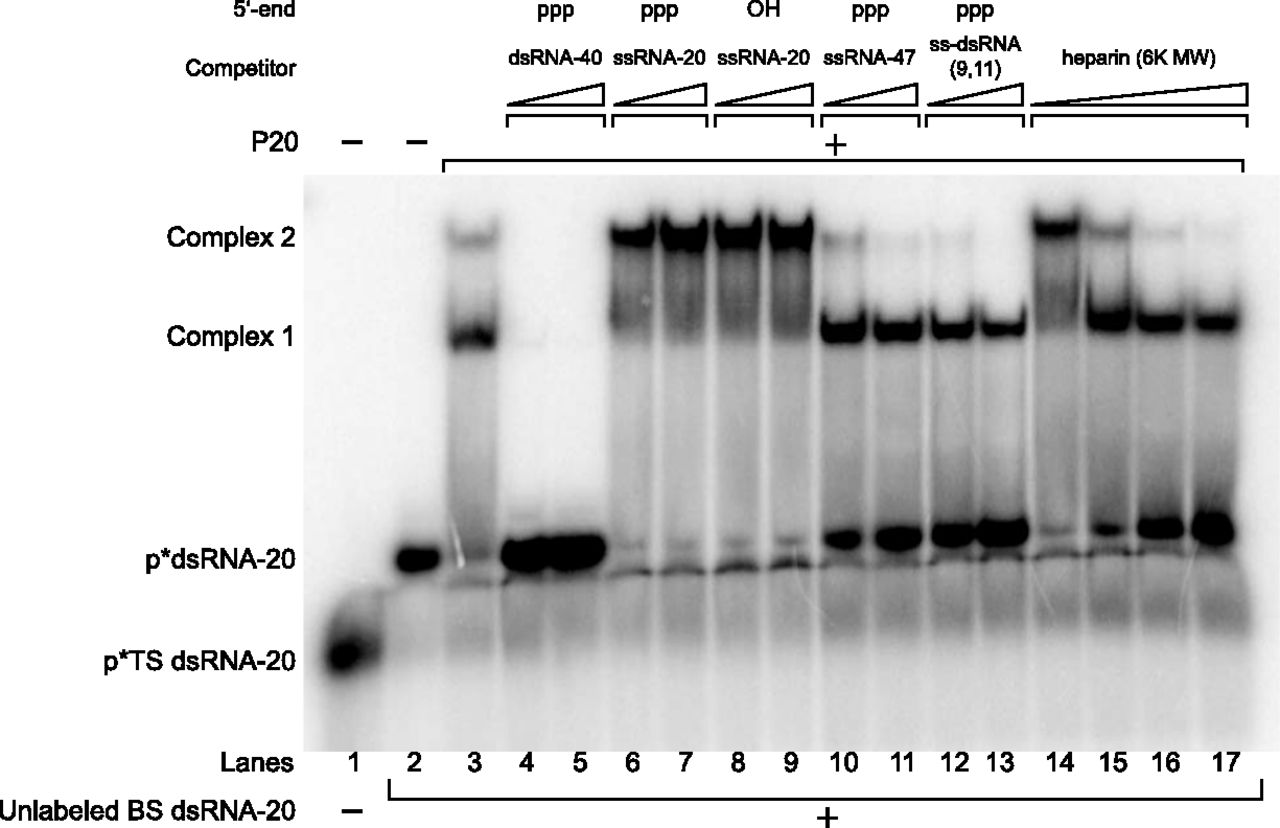
Competition for P20 binding by dsRNA, ssRNA, and heparin by EMSAs. A trace amount of p*dsRNA-20 was incubated with P20 in the presence of various unlabeled competitors and analyzed by 10% native PAGE. Top strand (TS) dsRNA-20 was 5′-32P-labeled and annealed to excess unlabeled bottom strand (BS). Formation of annealed p*dsRNA-20 duplex was confirmed by the microshift of p*TS in the presence of BS (lane 2). A no-competitor mobility shift was detected upon addition of 3 μM P20, with slight formation of a second complex (lane 3). In the remaining lanes, 3 μM P20 bound to trace p*dsRNA-20 was challenged with either unlabeled RNA or heparin competitor. Competitor RNA concentrations were 5 and 10 μM, and heparin concentrations were 10, 100, 1000, and 2000 μg/mL. Mobility of p*dsRNA-20, free and bound to P20 complexes, is indicated.