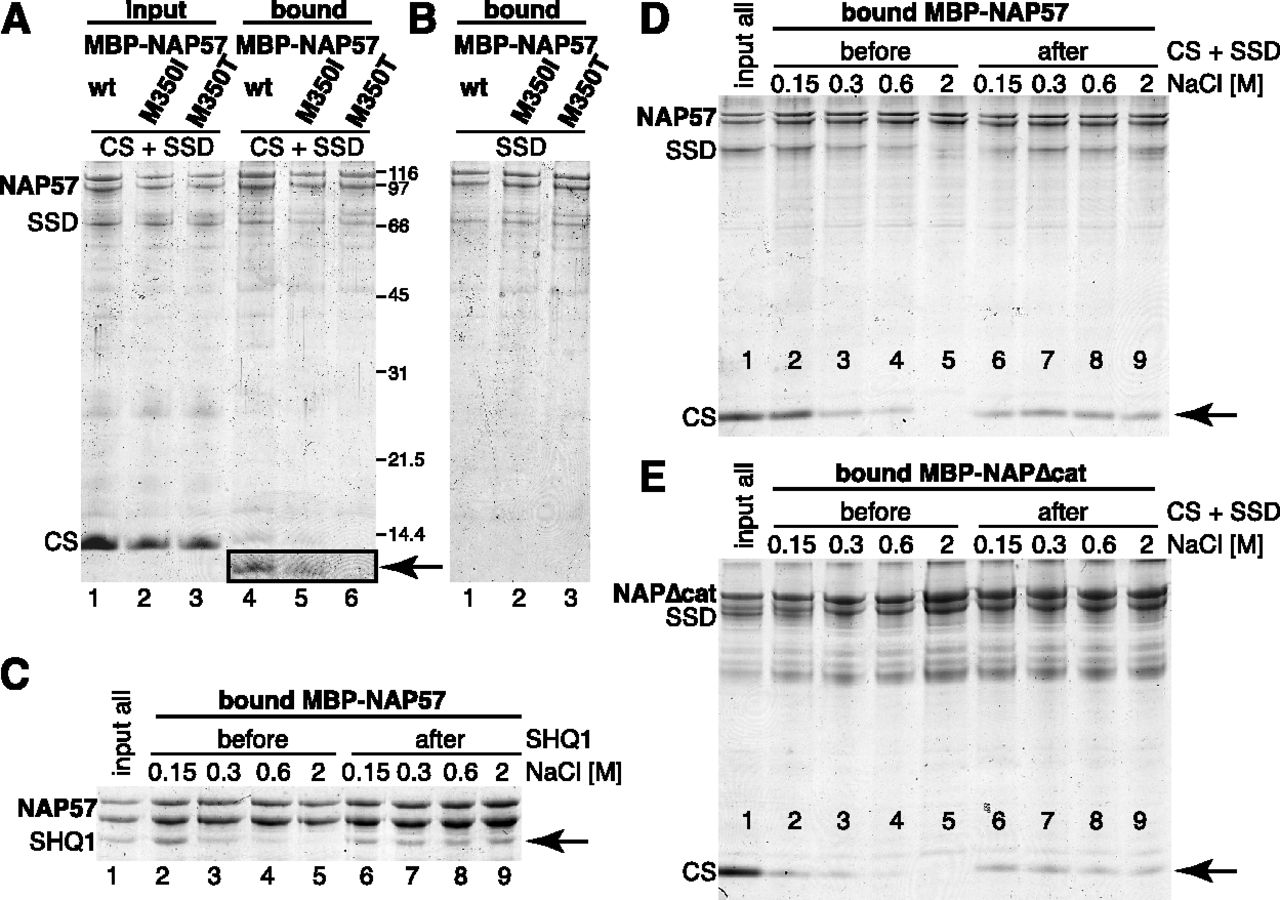
The CS domain of SHQ1 binds to the major X-DC mutation cluster of NAP57, forming a tight clamp together with the SSD. Amylose resin pull-down assays as in Figure 1G–K. (A) Binding of the CS domain of SHQ1 in trans to its SSD to wild-type and X-DC mutant NAP57. The hypomorphic M350T mutation abolishes binding of the CS domain of SHQ1, but not of the SSD. A contrast-enhanced image of the area right above where the CS domain migrates is outlined (boxed). (B) The SSD alone binds to NAP57 with X-DC mutations. (C) Increasing salt beyond physiological levels abolishes SHQ1 binding to NAP57 (lanes 2–5) but even 2 M salt is unable to release SHQ1 once bound (lanes 6–9). (D) As in C, but binding to NAP57 of the CS domain of SHQ1 in trans to its SSD. Only binding of the CS domain, but not that of the SSD, is salt sensitive (lanes 2–5) and neither is released once bound (lanes 6–9). (E) As in D, but binding to NAPΔcat.