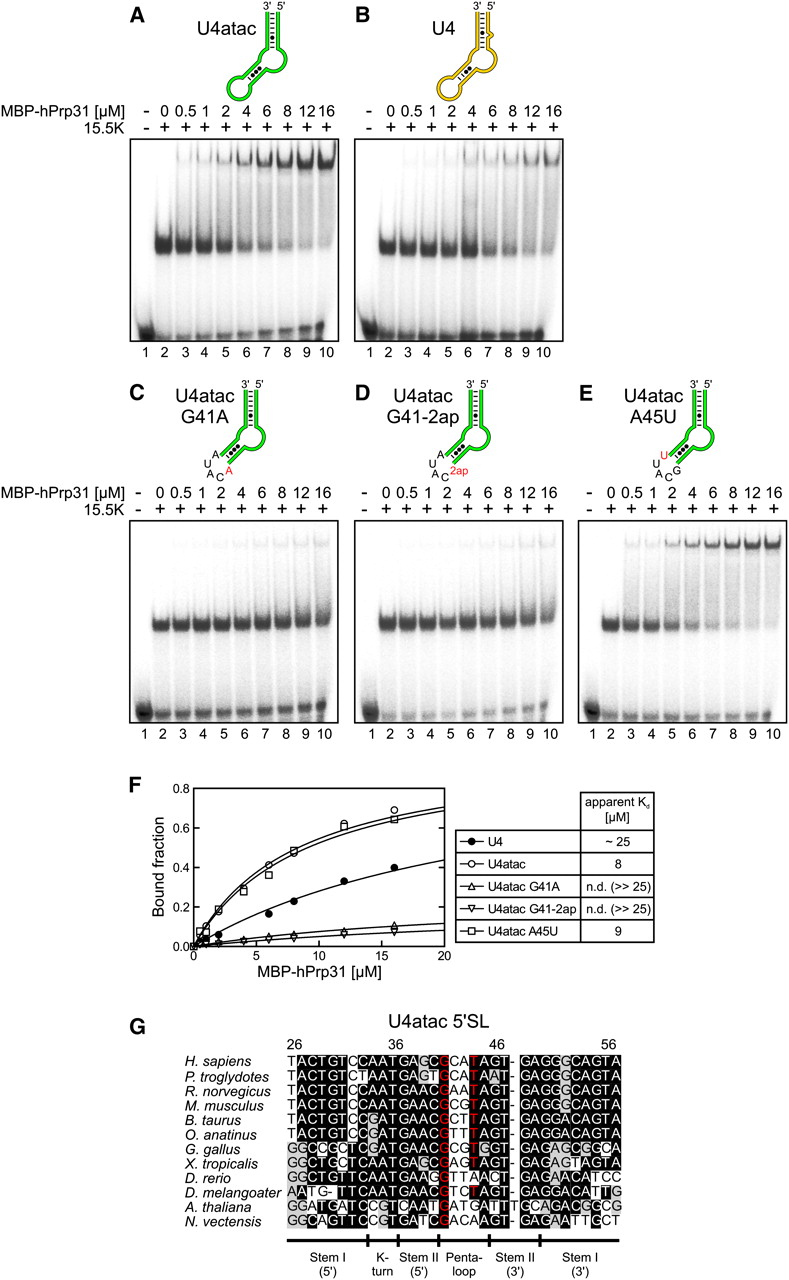
Differential RNP stabilities. (A,B) Binding of a maltose-binding protein (MBP) –hPrp31 fusion to binary complexes of protein 15.5K and U4atac (A) or U4 (B) 5′SLs monitored by EMSA. Increasing amounts of MBP–hPrp31 (0, 0.5, 1, 2, 4, 6, 8, 12, or 16 μM final concentration) were added to [32P]-5′-end labeled RNA oligonucleotides and 1 μM 15.5K protein. The higher stability of the U4atac-based ternary complex is apparent from the hPrp31-dependent super-shift and the disappearance of the binary complex at lower hPrp31 concentrations compared with the U4-based complex. (C–E) Testing of the effects of mutations in the U4atac snRNA pentaloop on the stability of the ternary complex using EMSA. Conditions as in A and B. Disruption of the noncanonical G41–U44 cross-loop base pair (G41A mutation) strongly attenuates ternary complex formation (C). Removal of one G41-R293 hydrogen bond by deletion of the O6 atom (G41-2ap mutation) severely weakens ternary complex formation (D). Change of the terminal, outward oriented nucleotide (A45U mutation) has no effect on the stability of the ternary complex (E). 2ap, 2-amino purine. Mutated positions are indicated in red in the schematics of the RNAs above the gel. (F) Quantification of the band shifts shown in A–E, and deduction of the apparent Kd’s. (n.d.) Not determined. (G) Multiple sequence alignment of U4atac 5′SLs. Nucleotides engaged in a noncanonical cross-loop base pair in human U4atac snRNP are shown in red. Numbering above the alignment refers to the human U4atac sequence. Structural elements of the 5′SLs are shown below the alignments. Species: Homo sapiens, Pan troglodytes, Rattus norvegicus, Mus muscullus, Bos taurus, Ornithorhynchus anatinus, Gallus gallus, Xenopus tropicalis, Danio rerio, Drosophila melanogaster, Arabidopsis thaliana, and Nematostella vectensis.