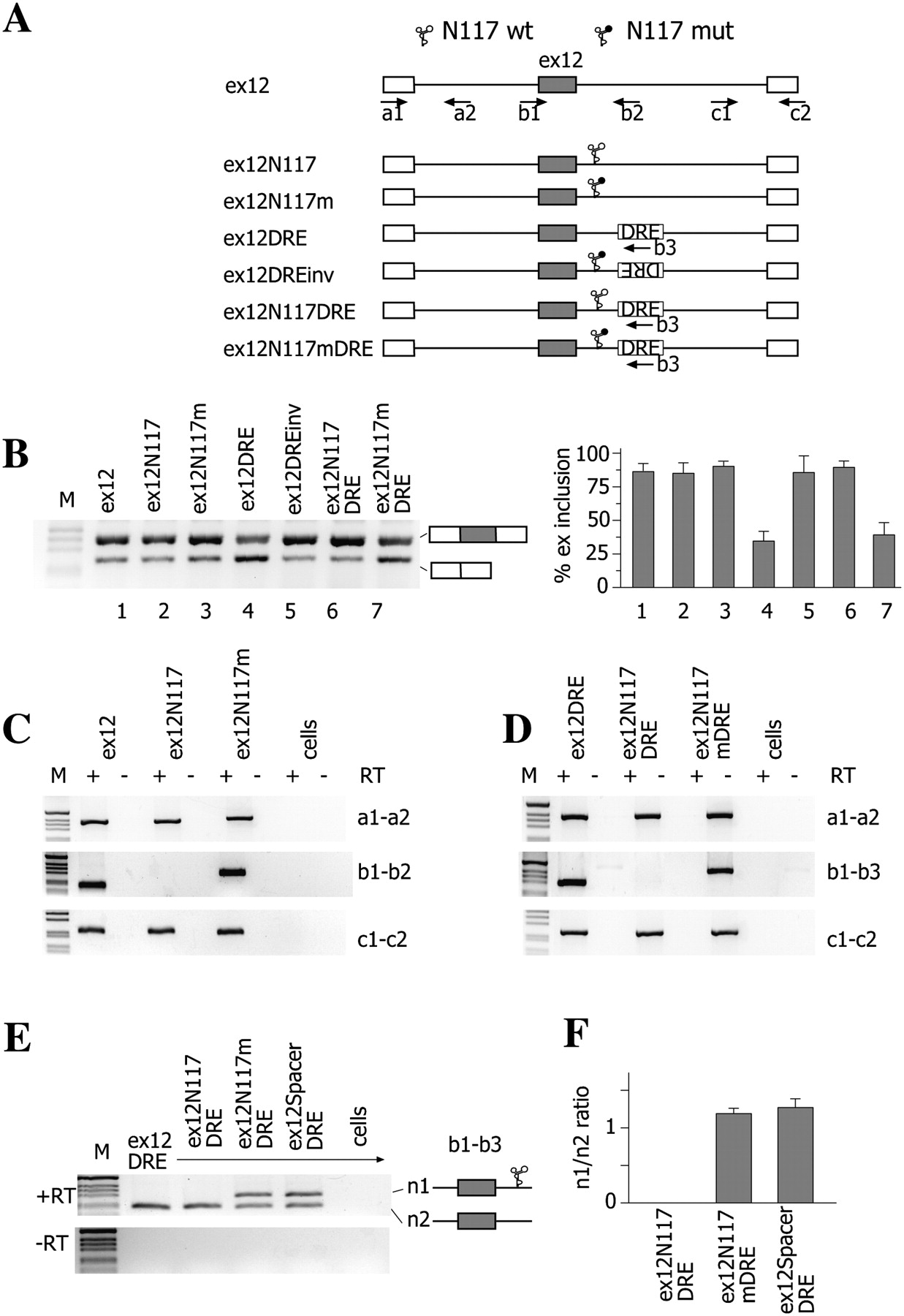
The N117 hammerhead ribozyme affects CFTR exon 12 alternative splicing in a DRE-dependent manner. (A) Schematic representation of the CFTR exon 12 minigenes. The positions of wild-type (WT) and mutant N117 ribozymes and of DRE are indicated. (Arrows) The locations of primers used in RT-PCR analysis. Exonic sequences are boxed. (B) Analysis of mature spliced transcripts. Minigenes were transfected into Hep3B cells, and RT-PCR products amplified with a1 and c2 primers were resolved on a 2% agarose gel. Exon 12 inclusion or exclusion forms are indicated. (M) The 1-kb molecular weight marker. The histogram shows the percentage of CFTR exon 12 inclusion (±SD) based on at least three independent duplicate experiments. (C,D) Analysis of nascent transcripts. Ex12 minigenes were transfected in Hep3B cells and analyzed with the indicated pairs of primers reported on the right of each panel. RT(−) is the control in absence of reverse transcriptase. (M) The 1-kb molecular weight marker. (E) Analysis of the b1–b3 pre-mRNA transcript. The indicated minigenes (0.45 μg) were cotransfected with pTB ex 12 DRE (0.15 μg). Total RNA was amplified with b1 and b3 primers, and the identity of the two resulting products (n1 and n2) is indicated. (Lower panel) The amplification without reverse transcriptase (−RT). (F) Quantification of pre-mRNA n1 and n2 ratio expressed as mean ± SD of two independent experiments done in duplicate.